Brahms: Sonata No.3, Op. 5 & Variations on a Theme by Paganini
10/25/2019, 34 Tracks, 57:18
Brahms's Piano Sonata Op. 5 may be an early work, but Argentinian pianist Nelson Goerner says that it "requires an interpreter who has reached maturity… to express all that it contains." On his first Brahms recital album, he plays this sonata alongside the exuberant Paganini Variations op. 35, "a marvel of inventiveness" in Goerne's words.
Featuring
Nelson Goerner
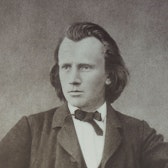
Johannes Brahms
Did you know?
1/7
Composition History
Brahms's Piano Sonata No. 3 in F minor, Op. 5, was composed when he was under twenty, with its movements written at different times and locations, some even signed with a pseudonym.
Critical Reception
Clara Schumann, a renowned pianist and composer, called Brahms's Paganini Variations 'Hexenvariationen' (Witch's Variations) due to their extreme difficulty.
Composition History
Brahms was encouraged by his lifelong friend, the violinist Joseph Joachim, to present his compositions to Robert and Clara Schumann in Düsseldorf, who were greatly impressed.
Composer Biography
Before the age of twenty, Johannes Brahms had already written a significant amount of music under various pseudonyms, though much of it was unpublished and later destroyed.
Composition History
Brahms composed the Paganini Variations for his friend Carl Tausig, a favorite pupil of Liszt and considered one of history's greatest pianists, who died young at 29.
Performer Biography
Nelson Goerner, the pianist on this recording, has had Brahms's F minor Sonata in his repertoire since the beginning of his career and has played it extensively in concert.
Compositional Technique
The F minor Sonata includes a reference to Beethoven's Fifth Symphony's 'Fate' motif and features the personal motto of Brahms's friend Joseph Joachim, 'Frei aber einsam' (Free but lonely), represented by the notes F-A-E.
You might also enjoy...
Beethoven: Various Piano Variations
Beethoven: Variations in C Minor, WoO 80 - Mendelssohn: Variations sérieuses, Op. 54 - Brahms: Variations on a Theme by Handel, Op. 24
Piano Recital: Margulis, Jura - Berg, A. / Brahms, J. / Beethoven, L. Van / Bach, J.S.
Piano Variations, Vol. 5 (Brahms & Handel)
Muthel: Piano Sonata in B-Flat Major / Piano Sonata in C Major / Arioso Nos. 1 and 2
Piano Variations, Vol. 3 (Mendelssohn, Schumann & Brahms)
Wolfram Schmitt-Leonardy Plays Romantic Piano Variations
Beethoven: Variations, Rondo a capriccio & Sonate No. 21 "Waldstein"
Beethoven: Variations On Arias by Italian Opera Composers