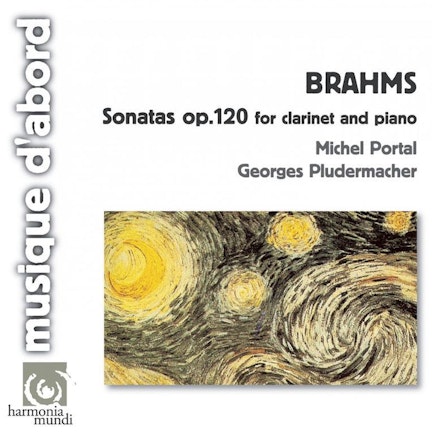
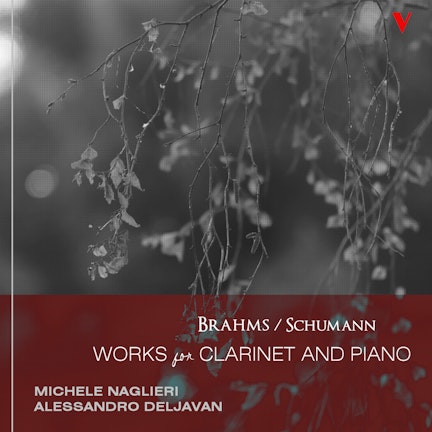
The Steinway grand piano of 1875 used in this recording was a preferred instrument of Brahms, who once stated he would "no longer play on any dubious or questionable instrument."
Instruments
The clarinet played by Richard Mühlfeld, for whom Brahms wrote these sonatas, was a unique Bärmann/Ottensteiner model made of boxwood, prioritizing a sweet sound over volume.
Interpretation
The performers on this album aim to explore less common interpretative options for Brahms's music, including tempo, rubato, phrasing, and articulation, drawing from early 20th-century recordings and historical information.
Composer Biography
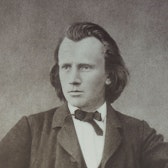
Johannes Brahms, at barely twenty years old, was praised by Robert Schumann as a musical prodigy, which put immense pressure on him.
Composition History
Brahms had declared he would stop composing in 1890/91, but his encounter with clarinettist Richard Mühlfeld inspired him to write four new chamber works, including the two sonatas on this album.
Compositional Technique
Brahms's late works, including these sonatas, feature pervasive but discreet canonic progressions and contrapuntal forms, handled with an elegance and ease unmatched since J.S. Bach.
Composer's Artistic Vision
Brahms's late music, though complex, was written with a newfound freedom and effortlessness, as he felt he no longer had anything to prove.
You might also enjoy...
Brahms, J.: Clarinet Sonatas Nos. 1 and 2 / Schumann, R.: Fantasiestücke
Brahms: Sonatas for Clarinet and Piano Nos. 1 and 2
Brahms, J.: Clarinet Sonatas Nos. 1 and 2
Brahms: The Clarinet Sonatas
Brahms: Sonatas for Clarinet and Piano, Op.120
Brahms: Clarinet Sonatas, Op. 120
Berg ∙ Brahms ∙ Poulenc ∙ Schumann: Sonatas for Clarinet and Piano