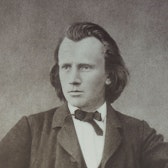
As a teenager, Brahms had to earn a living by playing piano in disreputable establishments in his native Hamburg.
Compositional Technique
The two string sextets were motivated by Brahms's feeling for rich sonorities, offering a luxuriance of textures not often heard in concert halls dominated by string quartets.
Composer Biography
Johannes Brahms was first hailed as a genius in October 1853 by Robert Schumann, in his famous publication Neue Zeitschrift für Musik.
Composer's Artistic Vision
Brahms's opposition to modernism stemmed from caution, believing that studying past masters would provide restraint and wisdom against a 'headlong drive into the future'.
Composer's Artistic Vision
Brahms, though romantic by nature, did not find opera or program music congenial, instead drawing strongest influence from the Classical tradition.
Composition History
The Second Sextet contains a musical motif based on the name Agathe von Siebold, the only young lady to whom Brahms was ever betrothed.
Composition History
Brahms was deeply self-critical, allowing only three of the fifteen string quartets he wrote to survive.
You might also enjoy...
Brahms - String Sextet No.2
Sextette Op. 18 & Op. 36
Bruch: String Quintet in E-Flat Major - Mendelssohn: String Quintets Nos. 1 & 2