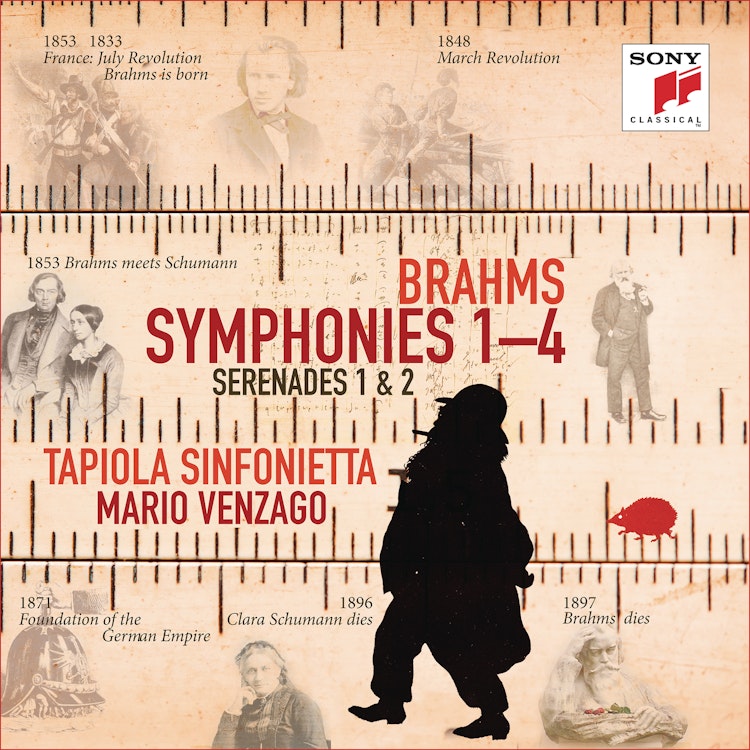
This complete recording of Brahms's symphonies and serenades was made in Tapiola, Finland, and produced by Andreas Werner.
Interpretation
Mario Venzago's interpretation of Brahms aims for a lighter, more transparent, coherent, and pleasant sound, contrasting with the heavier interpretations of the 1970s.
Composer's Artistic Vision
Brahms's music incorporates new sounds from composers like Liszt, Berlioz, and Wagner, integrating them into the general substance of his work despite his distaste for such aestheticism.
Performer Biography
Mario Venzago, the conductor, is the principal conductor of the Bern Symphony Orchestra and has recorded complete symphony cycles by Robert Schumann and Anton Bruckner.
Compositional Technique
Brahms uses metrical stress to create syncopation and hemiolas, a technique closer to Haydn's Classical idiom than Schumann's rubato-rich blurring of bar-lines.
Interpretation
Conductor Mario Venzago chose to record Brahms with a small-scale orchestra, similar to what Brahms had in Meiningen, using an undogmatic historical performance practice with sparse string vibrato and a focus on woodwind.
Compositional Technique
Brahms's symphonies contain many hidden dedications and musical allusions to Clara Schumann and her husband Robert Schumann, such as a horn tune recalling a hike with Clara and a solo oboe quoting Robert Schumann's 'Liederkreis'.