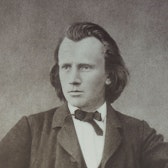
Brahms's first two sets of Hungarian Dances for piano duet became immediately and enduringly popular after their publication in 1869.
Composer's Artistic Vision
Brahms referred to his Second Symphony as 'the happy Symphony' due to its lyricism and joy, contrasting with his First Symphony's dramatic journey.
Composer's Artistic Vision
Despite its joyful character, Brahms revealed a melancholic side to his Second Symphony, linking it to his motet 'Warum ist das Licht gegeben dem Mühseligen?'.
Composer Biography
Brahms learned of Hungarian gypsy music from his violinist friend Eduard Reményi in the early 1850s and loved it throughout his life, even featuring his first Hungarian Dance in his only phonograph recording.
Compositional Technique
The Second Symphony opens with a four-note figure in the cellos and basses that acts as a 'pre-thematic' motto for other themes, originating from the finale of his First Symphony.
Composition History
Brahms began composing his Second Symphony almost immediately after completing his First Symphony, working on it in the summer of 1877.
Notable Performances
The first performance of Brahms's Second Symphony was given by the Orchestra of the Philharmonic Concerts (now the Vienna Philharmonic) on December 30, 1877, with the third movement encored.
You might also enjoy...
Brahms: Symphony No.4/Hungarian Dances
Brahms: Symphony No. 1 & Hungarian Dance No. 6
Brahms: Symphony No. 1 in C Minor, Op. 68 - Dvořák: Symphony No. 6 in D Major, Op. 60, B. 112