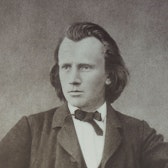
Johannes Brahms met two Hungarian violinists, Eduard Reményi and Joseph Joachim, in the 1850s, who significantly influenced his musical career.
Historical Context
The 'Hungarian gypsy music' that influenced Brahms was an amalgam of Hungarian styles interpreted by Romani gypsies, widely popular in the 19th century.
Compositional Technique
The final movement of Brahms' Violin Concerto is an 'exuberant 'Rondo alla Zingarese'' (rondo in the Hungarian style), reflecting his love for Hungarian gypsy music.
Composition History
While Brahms orchestrated some of his Hungarian Dances, others were orchestrated by dedicated supporters like Antonín Dvořák, who claimed they influenced his own Slavonic Dances.
Composition History
Brahms composed his Violin Concerto specifically for his friend Joseph Joachim, a violinist, and sought his advice on the violin part.
Critical Reception
After its premiere, the Violin Concerto was famously remarked by conductor Josef Hellmesberger as a concerto 'not for, but against the violin' due to its symphonic scope.
Composition History
The Violin Concerto in D Major, Op. 77, was written by Brahms in 1878 while holidaying in Pörtschach, where he had also composed his Second Symphony.
You might also enjoy...
Brahms: Violin Concerto
Brahms: Violin Concerto in D Major, Op. 77
Brahms: Violin Concerto in D Major, Op. 77
Brahms: Violin Concerto in D Major, Op. 77
Brahms: Violin Concerto
Brahms: Violin Concerto in D Major, Op. 77 (Live in Utrecht, 9/30/2003)
Brahms: Violin Concerto
Brahms: Concerto for Violin and Orchestra in D Major, Op. 77
Brahms: Violin Concerto in D Major, Op. 77
Brahms: Violin Concerto
Brahms: Violin Concerto ("Masterworks")
Brahms: 21 Hungarian Dances, WoO 1: No. 5 in G Minor. Allegro