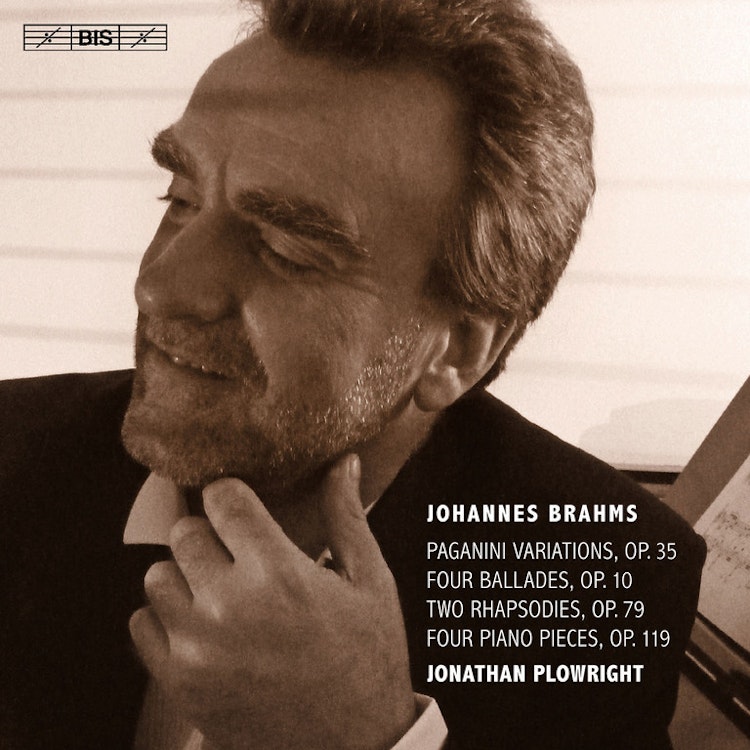
The theme for Brahms's Paganini Variations comes from Niccolò Paganini's 24th violin Caprice, a popular theme also used by composers like Schumann, Liszt, and Rachmaninov.
Critical Reception
Some contemporaries, like Hugo Wolf and Pyotr Ilyich Tchaikovsky, strongly disliked Brahms's music, with Tchaikovsky calling him "a giftless bastard."
Composer's Artistic Vision
Brahms's genius was described as having a "Janus-like capacity" to recall past glory, like Beethoven's, while also forging a new and prophetic musical language.
Performer Biography
Jonathan Plowright, the pianist on this recording, is a gold medallist of the Royal Academy of Music and a Fulbright Scholar, recognized as an exceptional performer.
Critical Reception
Clara Schumann, a close friend of Brahms, found his Paganini Variations to be "witch variations" and "beyond a woman's strength or inclination."
Historical Context
Brahms's late piano works were composed concurrently with Debussy's Prélude à l'après-midi d'un faune, highlighting a period of significant musical transition.
Composition History
The first of Brahms's Four Ballades, the "Edward" Ballade, is uniquely based on a grisly Scottish poem from Herder's Stimmen der Völker in Liedern, which Brahms also set as a duet.
You might also enjoy...
Solzhenitsyn Plays Brahms
Brahms: Piano Works
Brahms: Selected Piano Music
Grieg
In Contrasts
Brahms: Works for Solo Piano, Vol. 5
Rachmaninov: Piano Works
Karol Mikuli, Aleksander Michałowki: Piano Works
Barmotin: Piano Music, Vol. 2
Brahms: Works for Solo Piano
Brahms. Piano Works Vol.2
Brahms: Symphony No. 4, Variations on a Theme by Paganini & 8 Klavierstücke (Live)