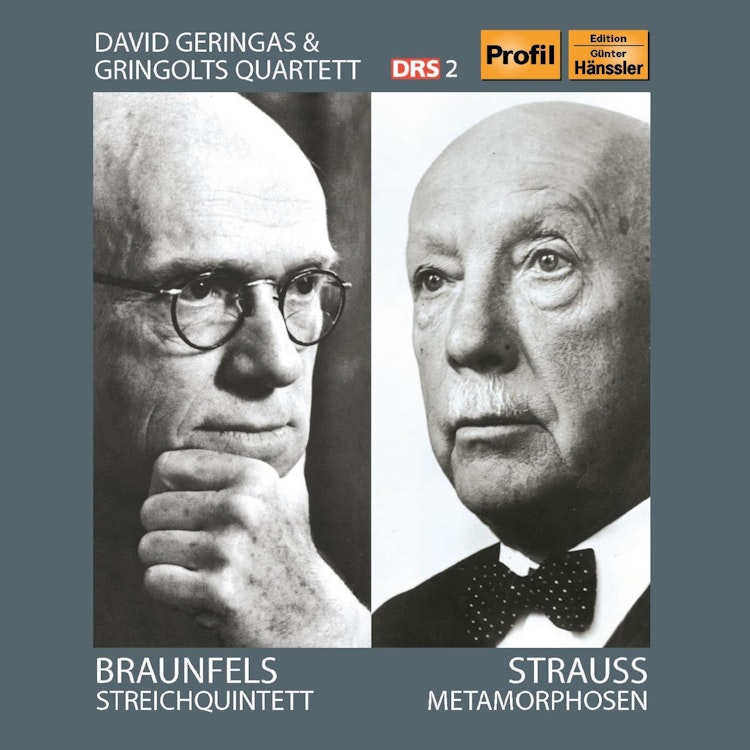
Richard Strauss viewed his Metamorphosen as a 'reflection of my whole past life' and a résumé of his artistic existence.
Composer Biography
Walter Braunfels, a pianist and composer, was classified as a 'half-Jew' under the Nazi regime and lost his position as director of the Cologne College of Music in 1933.
Compositional Technique
Richard Strauss's Metamorphosen, despite its title, refers to the constant modification and variation of three theme groups, uniting in a 'melodic polyphony'.
Compositional Technique
Towards the end of Metamorphosen, Richard Strauss unconsciously incorporated a theme from Beethoven's 'Eroica' Symphony – the beginning of its funeral march.
Composer Biography
Richard Strauss, as president of the Reichsmusikkammer, indirectly supported the Nazi system, which damaged his reputation after the war.
Historical Context
Both works on this album, Walter Braunfels's String Quintet and Richard Strauss's Metamorphosen, were composed in the momentous year of 1945, at the end of World War II.
Performer Biography
David Geringas, the cellist and conductor on this recording, was a pupil of Mstislav Rostropovich and won first prize and a gold medal at the Tchaikovsky Competition in 1970.