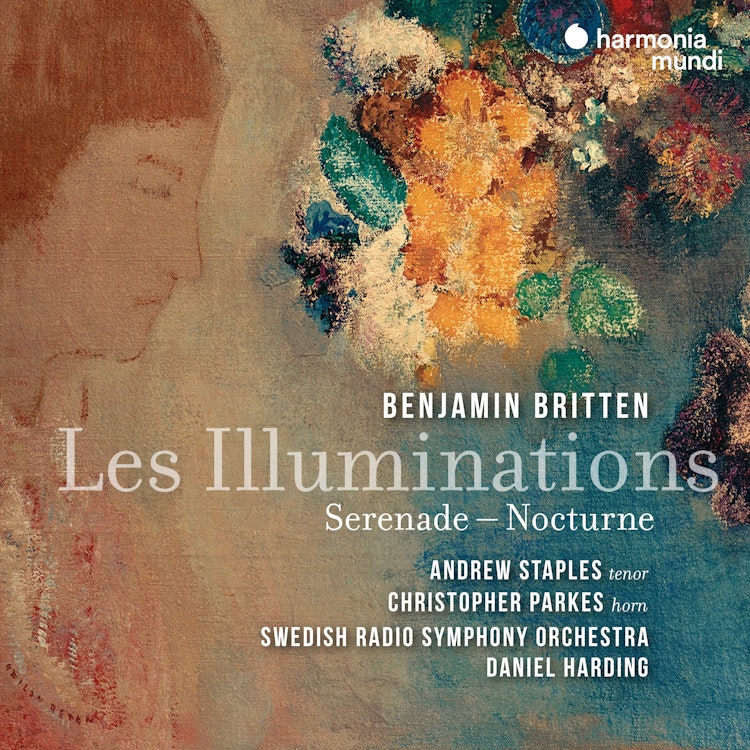
Britten's Les Illuminations was dedicated to soprano Sophie Wyss, who premiered it in London in 1940, months after Britten arrived in North America and war broke out in Europe.
Compositional Technique
In Nocturne, Britten uses a continuous flow of psychological states, linked by a string ritornello that functions as both a lullaby and a heartbeat.
Composer's Artistic Vision
Britten described his Nocturne as 'the strangest & remotest thing,' noting that dreams themselves are strange and remote.
Composer's Artistic Vision
Britten's interest in Rimbaud's poetry for Les Illuminations reflected his own nascent erotic life, his desire to travel abroad, and his growing intimacy with Peter Pears, his lifelong partner.
Composer Biography
Benjamin Britten was drawn to composing song cycles throughout his career, constantly redefining the genre both formally and emotionally.
Composition History
Britten conceived the Serenade for tenor, horn, and strings in 1942 after meeting Dennis Brain, the 21-year-old principal horn in the RAF Orchestra.
Historical Context
Britten completed the Serenade in April 1943 while bedridden with measles, and he could hear air-raid sirens as he composed.
You might also enjoy...
Britten: Serenade / Les Illuminations / Nocturne
Britten: Serenade for Tenor / Les Illuminations / Nocturne
Britten: Les Illuminations, Serenade, Nocturne, Noye's Fludde
The World Is Babel and Ivory
Finzi: Love's Labour's Lost - Let us garlands bring - 2 Sonnets - Farewell to Arms - In terra pax
Cecilia McDowall: Cantatas
Stenhammar / Heise / Lange-Muller / Malling / Nielsen / Grieg: Songs for Baritone and Orchestra
Shostakovich: 6 Romances, Op. 62a, Scottish Ballade - Suite on Verses of Michelangelo Buonarroti, Op. 145a
O Sole Mio - Neapolitan Folk Songs
Bridge: Orchestral Works, Vol. 6
Sibelius, J.: Sibelius Edition, Vol. 3 - Voice and Orchestra