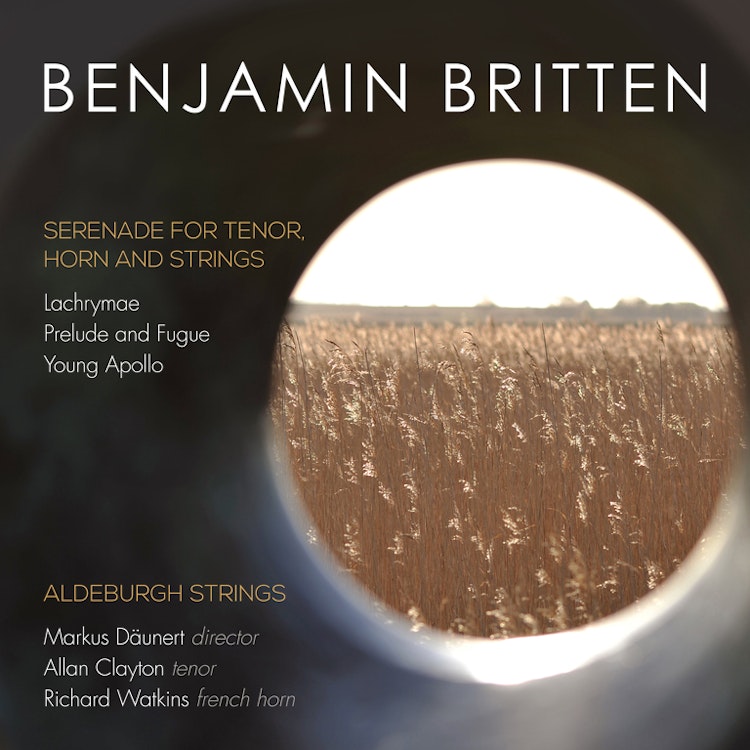
Britten's Prelude and Fugue, Op. 29, was a personalized anniversary present for the Boyd Neel String Orchestra's tenth anniversary, with a separate part written for each of its eighteen players.
Composition History
The Serenade for tenor, horn and strings, Op. 31, was originally conceived as a horn concerto for Dennis Brain, but evolved into an orchestral song cycle at his publisher's suggestion.
Composition History
Benjamin Britten's Young Apollo was commissioned by the Canadian Broadcasting Corporation in 1939, for which Britten appeared as soloist in its first performance.
Cultural Impact
The Serenade for tenor, horn and strings, Op. 31, was an instant success at its 1943 premiere and firmly secured the international reputations of both Britten and Peter Pears, the tenor soloist.
Compositional Technique
Britten's Lachrymae, Op. 48a, is a 'theme and variations in reverse', where the music gradually merges into the simple harmonic idiom of John Dowland's original song at the end.
Composer's Artistic Vision
Britten's Young Apollo was inspired by John Keats's poem Hyperion, depicting the new Sun-god Apollo 'quivering with radiant vitality'.
Composer Biography
Britten suppressed Young Apollo for decades because it was inspired by his love for Wulff Scherchen, the son of renowned German conductor Hermann Scherchen, a fact that caused embarrassment during wartime.
You might also enjoy...
Maw: La Vita Nuova; Ghost Dances; Roman Canticle
Snowflakes - A Classical Christmas
Varèse: The Complete Works
Arvo Pärt: Musica Selecta - A Sequence By Manfred Eicher