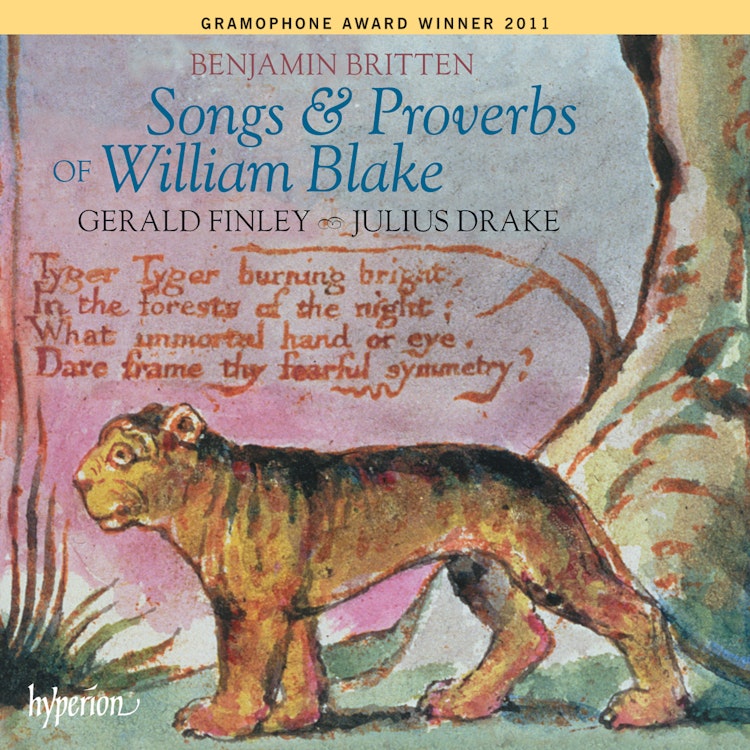
Britten: Songs & Proverbs of William Blake; Tit for Tat & Other Songs
7/28/2023, 33 Tracks, 1:14:16
Featuring
Gerald Finley
Julius Drake
Benjamin Britten
Did you know?
1/7
Composer's Artistic Vision
In Britten's later music, the tension between luminous diatonicism and elusive chromaticism often symbolizes the conflict between innocence and experience at the heart of William Blake's poetry.
Composition History
The song cycle Songs and Proverbs of William Blake was designed to showcase the unique blend of intense lyricism and dramatic characterization of German baritone Dietrich Fischer-Dieskau.
Compositional Technique
The stark Proverbs in Britten's cycle are distinguished from the songs they punctuate by their disconcerting lack of metrical synchronization between voice and piano.
Compositional Technique
In Britten's Songs and Proverbs of William Blake, the Proverbs are set to recurrent but constantly reworked ritornello material, a structural plan familiar from other Britten works.
Composer Biography
Benjamin Britten composed a substantial body of music for the tenor voice, mostly inspired by his long-term partner and creative muse, Peter Pears.
Recording & Production
This recording was made in All Saints, Durham Road, East Finchley, London, on December 11-13, 2008, with Julian Millard as Recording Engineer and Mark Brown as Recording Producer.
Composer Biography
Britten's output for low voice was inspired by specific performers he was closely associated with, including Dietrich Fischer-Dieskau, John Shirley-Quirk, Owen Brannigan, and Benjamin Luxon.
You might also enjoy...
Britten: Complete Scottish Songs
Vaughan Williams: On Wenlock Edge / Five Mystical Songs (English Song, Vol. 3)
Britten: Songs Vol. 2
The Contrast: English Poetry in Song
Moeran: Complete Solo Songs
Bax: 21 Songs
Britten: 7 Sonnets of Michelangelo / Holy Sonnets of J. Donne / Winter Words (English Song, Vol. 7)