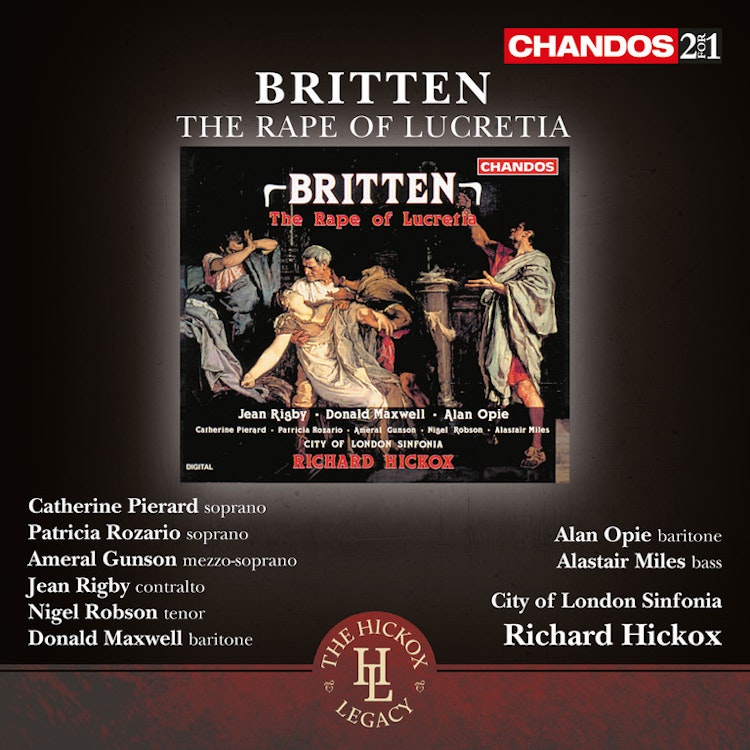
Benjamin Britten's opera, The Rape of Lucretia, marked a turning point in his career, following the international acclaim of Peter Grimes.
Critical Reception
The ending of the opera, with its Christian message, was a 'bone of contention' for librettist Ronald Duncan and critics like Desmond Shawe-Taylor, but Britten left it untouched in revisions.
Performer Biography
Richard Hickox, the conductor of this recording, was a highly gifted British conductor who served as Music Director of Opera Australia and founded the City of London Sinfonia in 1971.
Composition History
The opera's shift away from 'grand opera' was partly motivated by Britten's uncomfortable experience mounting Peter Grimes at Sadler's Wells and limited prospects for future commissions.
Composer's Artistic Vision
Britten and librettist Ronald Duncan intentionally placed the story of Lucretia within a Christian ethical context, reinforced by the Prologue and Epilogue acting as a 'frame' offering salvation and atonement.
Compositional Technique
The opera uses a small cast, a 'chorus' embodied by a single male and female narrator, and a twelve-piece chamber orchestra, a decisive break from the epic scale of Britten's earlier work, Peter Grimes.
Composition History
The creation of The Rape of Lucretia led to the formation of the English Opera Group and, subsequently, the Aldeburgh Festival in 1948, founded by Britten and Peter Pears.
You might also enjoy...
Strauss, R.: Arabella
Britten : Billy Budd
Britten: Peter Grimes
Britten: A Midsummer Night's Dream
Heinio: the Knight and the Dragon
Arnold Rosner: The Chronicle of Nine (The Tragedy of Queen Jane)