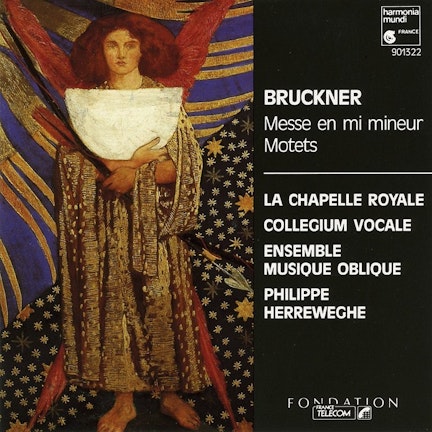
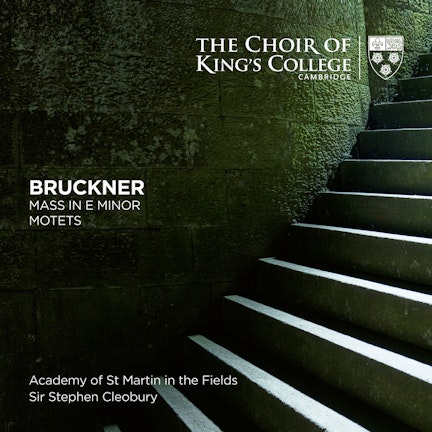
Bruckner: Mass in E minor & Motets & "BRUCKNER'S WORLD" - An introduction to the works
5/3/2024, 27 Tracks, 2:13:17
Featuring
Peter Dijkstra
Wiebke Puls
Johannes Silberschneider
Hans Jürgen Stockerl
Hemma Michel
Friedrich Schloffer
Chor des Bayerischen Rundfunks
Münchner Rundfunkorchester
Anton Bruckner
Markus Vanhoefer
Did you know?
1/7
Composition History
Bruckner's two 'Aequale' pieces, a genre for multiple equal instruments often trombones, were written in January 1847 for the death of his great-aunt and godmother Rosalia Mayrhofer.
Compositional Technique
Bruckner chose an unusual scoring for his Mass in E minor, featuring an eight-part choir accompanied only by wind instruments, due to the outdoor setting and the new chapel being too small for the choir.
Composer's Artistic Vision
Bruckner's early religious convictions and training led him to initially view himself as a church musician before expanding into symphonic music.
Notable Performances
The premiere of Bruckner's Mass in E minor was a great success, leading to him being invited to the bishop's banquet table, which he later called the 'most glorious day' of his life.
Composer Biography
Anton Bruckner, the composer, entered the Augustinian canons' monastery of St Florian near Linz as a choirboy at the age of 13 and later worked there as an organist.
Compositional Technique
The 'Aequale' pieces, composed by Bruckner when he was barely twenty, foreshadow the monumental chorale passages that became important features of his later symphonies.
Composition History
Bruckner's Mass in E minor was commissioned by Bishop Franz Joseph Rudigier for the consecration of the votive chapel in the new cathedral in Linz.
You might also enjoy...
Bruckner: Mass in E Minor & Motets
Mozart, W.A.: Requiem / Ave Verum Corpus / Bruckner, A.: Ave Maria / Locus Iste / Christus Factus Est
Mozart: Requiem & Ave verum corpus - Bruckner: Motets