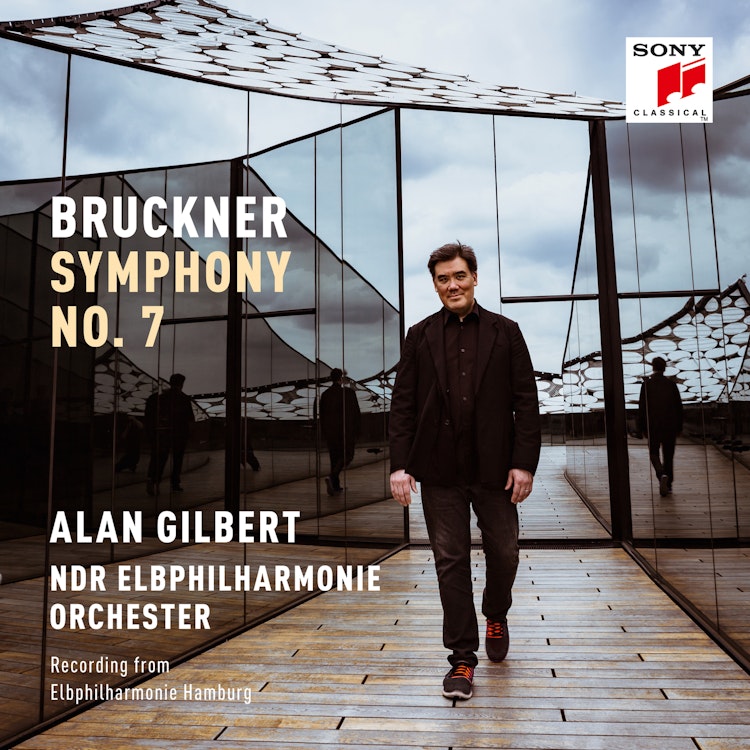
Alan Gilbert, the new chief conductor of the NDR Elbphilharmonie Orchester, makes his first recording with the orchestra for Sony Classical. Bruckner's Seventh Symphony in E major is among his most popular works and was a career breakthrough for the Austrian composer after its 1884 premiere, with its Adagio especially well loved.
Featuring
Alan Gilbert
NDR Elbphilharmonie Orchester
Anton Bruckner
Did you know?
1/7
Composer Biography
Anton Bruckner, the composer, adopted a servile attitude towards influential individuals and even his own pupils, like the brothers Franz and Josef Schalk, to gain recognition for his music.
Recording & Production
This recording of Bruckner's Symphony No. 7 was made in the Großer Saal of the Elbphilharmonie Hamburg in June 2019.
Critical Reception
Despite initial criticism from the 'Hanslick-Brahms faction' in Vienna, the Seventh Symphony made a triumphant tour through musical metropolises worldwide after its Leipzig premiere.
Composition History
Bruckner's Seventh Symphony achieved its international breakthrough at its 1884 Leipzig premiere, conducted by Arthur Nikisch, who was only 28 at the time.
Compositional Technique
The famous Adagio movement of the Seventh Symphony features four Wagner tubas, which Bruckner added after Richard Wagner's death in 1883, viewing the news as a 'disaster'.
Composer Biography
Arthur Nikisch, the conductor of the premiere, had played violin with the Vienna Philharmonic during the 1873 unveiling of Bruckner's Second Symphony, which proved a seminal experience for him.
Compositional Technique
The theme at the start of the Adagio, now colored by the dark sonorities of the Wagner tubas, was originally intended for violas and low winds.
You might also enjoy...
Bruckner: Symphony No. 8
Bruckner : Symphony No.5
Bruckner: Symphony No. 7 in E Major
Bruckner: Symphony No. 7 in E Major
Bruckner: Symphonies No. 5 & 8 (Live at Philharmonie am Gasteig, Munich, 1993)
Anton Bruckner: Symphonie 8
Bruckner: Symphony No. 9 in D Minor, WAB 109
Bruckner: Symphony No. 4
Tandem Bruckner/Wand
Bruckner: Symphony No. 1 in C Minor, WAB 101 (1877 Linz Version, ed. R. Haas)
Bruckner: Symphony No.1 in C Minor, WAB 101 (Linz Version)
Bruckner: Symphony No. 1 in C Minor
Bruckner: Symphony No. 3 in D Minor, WAB 103 "Wagner" (1889 Version) [Live]