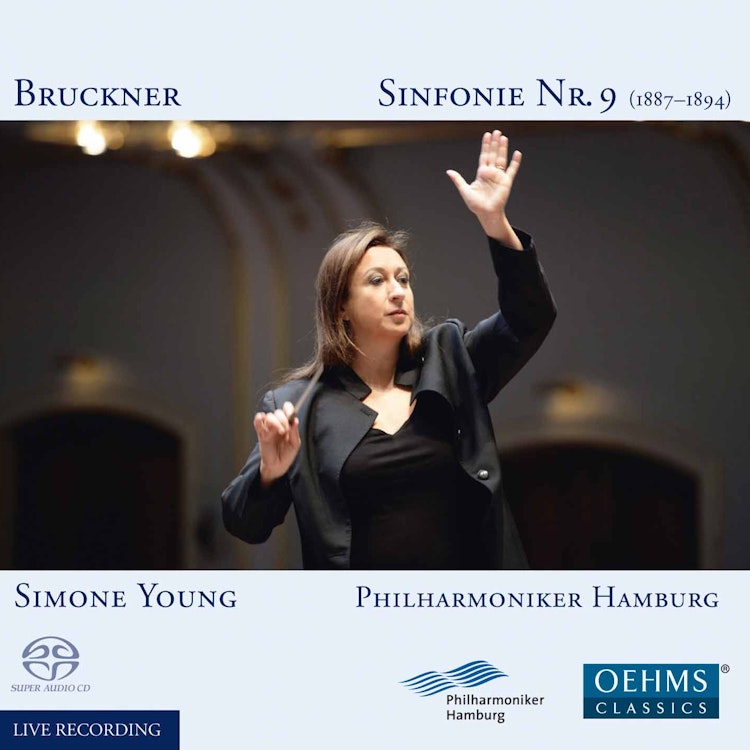
Bruckner: Symphony No. 9 in D Minor, WAB 109 (Live)
7/3/2015, 3 Tracks, 58:59
Featuring
Simone Young
Philharmonisches Staatsorchester Hamburg
Anton Bruckner
Did you know?
1/7
Composition History
Bruckner died while working on the unfinished fourth movement of his Ninth Symphony on October 11, 1896.
Compositional Technique
The choice of D minor for Bruckner's Ninth Symphony was a deliberate reference to Beethoven's own last symphony, also in D minor, which Bruckner considered the pinnacle of symphonic composition.
Performer Biography
Simone Young, the conductor on this recording, has been the Artistic Director of the Hamburg State Opera and Chief Music Director of the Hamburg Philharmonic since August 2005.
Composer's Artistic Vision
Bruckner intended his Ninth Symphony to be dedicated to 'the good Lord,' unlike his previous symphonies dedicated to a king or an emperor.
Recording & Production
This recording is part of a complete cycle of Bruckner symphonies released by Simone Young and the Hamburg Philharmonic.
Composition History
Anton Bruckner worked on his Ninth Symphony for nine years, viewing it as his testament and the crowning achievement of his work.
Composer's Artistic Vision
Bruckner suggested that if he could not finish the symphony, his Te Deum could be played as the final movement, emphasizing a radiant praise of God over a resigned ending.
You might also enjoy...
Bruckner: Symphony No. 8
Bruckner : Symphony No.5
Bruckner: Symphony No. 7 in E Major
Bruckner: Symphony No. 7 in E Major
Bruckner: Symphonies No. 5 & 8 (Live at Philharmonie am Gasteig, Munich, 1993)
Anton Bruckner: Symphonie 8
Bruckner: Symphony No. 9 in D Minor, WAB 109
Bruckner: Symphony No. 4
Tandem Bruckner/Wand
Bruckner: Symphony No. 1 in C Minor, WAB 101 (1877 Linz Version, ed. R. Haas)
Bruckner: Symphony No.1 in C Minor, WAB 101 (Linz Version)
Bruckner: Symphony No. 1 in C Minor
Bruckner: Symphony No. 3 in D Minor, WAB 103 "Wagner" (1889 Version) [Live]