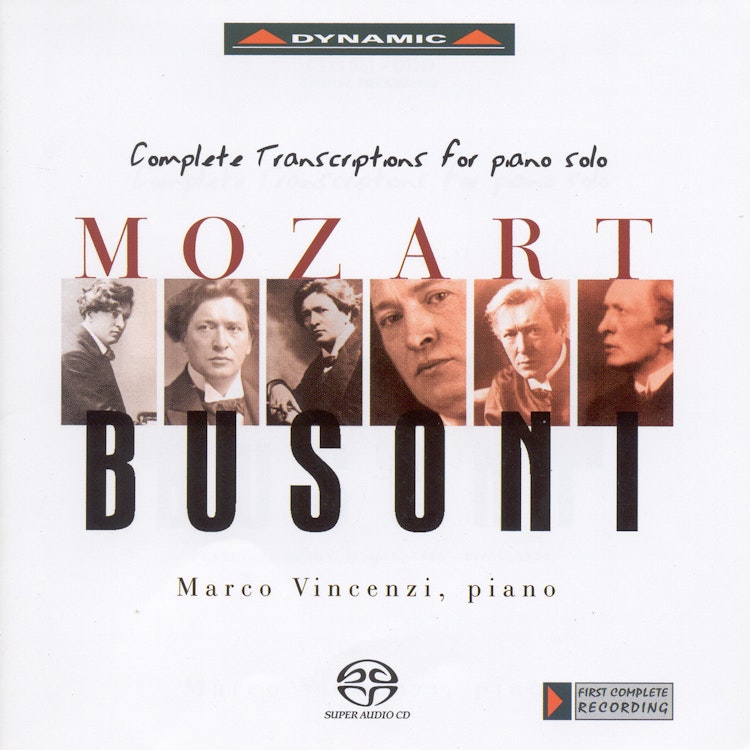
Busoni: Mozart - Symphonies Nos. 30, 32 and 37 / Variations - Study After Mozart's Serenata From Don Giovanni / An Die Jugend (Excerpt)
7/1/2000, 16 Tracks, 1:03:29
Featuring
Marco Vincenzi
Ferruccio Busoni
Did you know?
1/7
Compositional Technique
In his transcription of the Serenade from Don Giovanni, Busoni uses 'blind octaves' (real octaves alternating with single notes) to imitate the mandolin's staccato accompaniment.
Compositional Technique
In his transcription of the Andantino from Mozart's Concerto K 271, Busoni adds a highly dramatic Cadenza, developing the intrinsic chromaticism of the original.
Compositional Technique
Busoni's transcriptions of Mozart's symphonies, dating from 1888, are described as more like a sketch than a full fresco, unlike his more luxuriant organ transcriptions.
Composition History
Mozart's Symphony K 444, transcribed by Busoni, actually features only a brief slow introduction by Mozart, with the rest of the symphony composed by Michael Haydn in 1783.
Composer's Artistic Vision
Ferruccio Busoni, the transcriber on this album, considered Mozart to be the greatest musician, a perpetual day of sunshine, and the most complete musical talent ever.
Performer Biography
Marco Vincenzi, the pianist on this recording, graduated summa cum laude from the Conservatory of Genoa and won the Prix de Virtuosité at the Geneva Conservatory.
Compositional Technique
Busoni's Giga, Bolero e Variazione (1909) combines a touched-up Mozart gigue, an instrumental passage from 'The Marriage of Figaro' (which Busoni calls Bolero), and a polyphonic variation of the gigue.
You might also enjoy...
Hindemith: 3 Piano Sonatas
Confrey: Piano Music
Hindemith: Piano Works, Vol. 3
Hindemith: Piano Works, Vol. 3
Cowell: Piano Music
Caroline Hong Plays Corigliano, Foss and Vine
Hindemith: Complete Sonatas, Vol. 3
Poulenc: Piano Works
Sun Bear Concerts
Rio
Schreker: Kammersymphonie (Arr. I. Strasfogel for Piano)