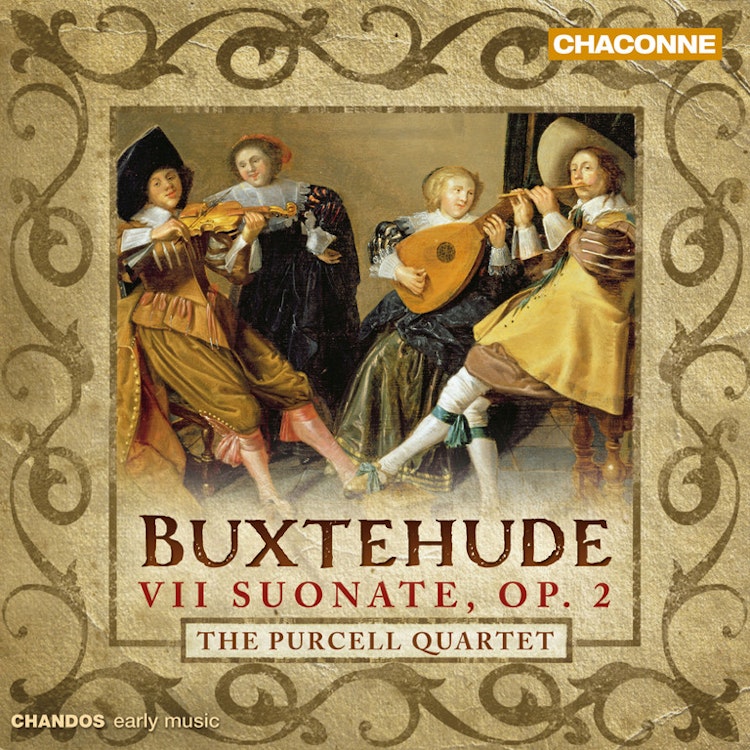
Dietrich Buxtehude, the composer, spent his entire career in towns around the Baltic Sea, including Helsingborg, Helsingør, and Lübeck.
Compositional Technique
Buxtehude's sonatas often feature sections constructed over a ground bass, with some treated strictly and others more freely, such as the Arietta of Suonata II which is a set of ten variations.
Historical Context
The sonata for violin, bass viol, and continuo, as used by Buxtehude, was a popular alternative to the standard trio sonata in Germany and central Europe, and was even exported to other countries.
Performer Biography
The Purcell Quartet, founded in 1983, has established itself as a leader in baroque chamber music, having made nearly fifty recordings and toured globally.
Recording & Production
This recording was made in All Saints' Church, East Finchley, London, in February 2011, using 24-bit recording technology for enhanced dynamic range and resolution.
Composition History
Buxtehude's Op. 2 sonatas were published in Hamburg in 1696 and were dedicated to Johann Ritter, a burgomaster of Lübeck and director of the Marienkirche, where Buxtehude was organist.
Compositional Technique
A distinctive feature of Buxtehude's sonatas is their scoring, where the viola da gamba's role is ambiguous and constantly changes, sometimes doubling the continuo and other times playing an independent alto part.
You might also enjoy...
Buxtehude: Trio Sonatas
Handel: Op. 2 Trios Sonatas
Biber: Harmonia Artificioso Ariosa
Bach, J.S.: Trio Sonatas, Bwv 525-530
Johann Pachelbel: Musicalische Ergetzung
Galuppi: Sei sonate a tre
Opera Omnia XV - Chamber music vol. 3
Buxtehude: Opera Omnia XIII: Chamber music vol. 2
Handel: Sonatas, Op.5
Buxtehude
Rebel: 7 Sonatas For Violines, Viola Da Gamba & Basso Continuo