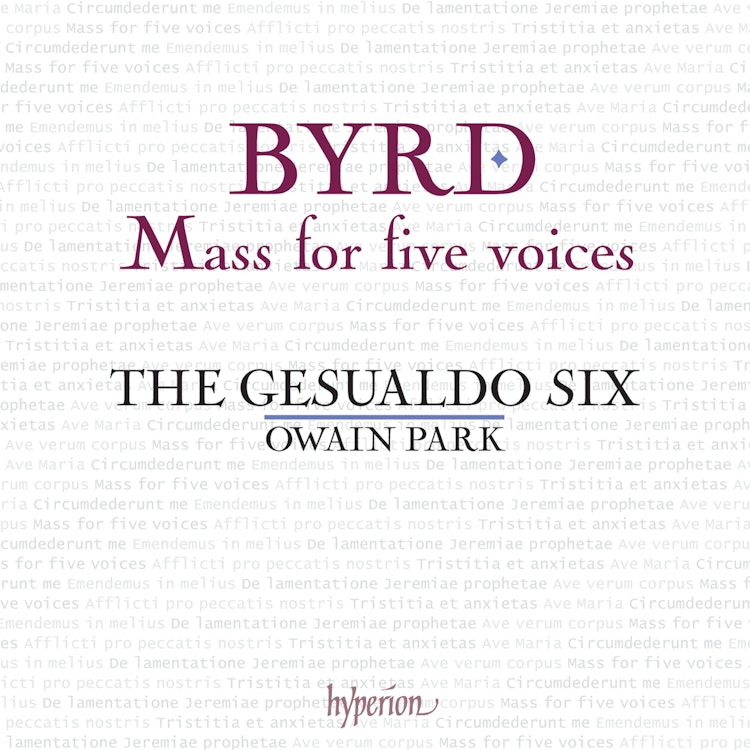
Byrd: Mass for Five Voices; Ave verum corpus; Lamentations & Other Works
7/28/2023, 29 Tracks, 1:06:27
Featuring
Owain Park
The Gesualdo Six
William Byrd
Did you know?
1/7
Compositional Technique
In 'Afflicti pro peccatis nostris', Byrd embeds a full chant in the fourth voice, forming a cantus firmus around which he weaves a six-part texture.
Composition History
Byrd's Mass for five voices was probably composed to be sung at great personal risk by small gatherings of recusants in domestic chapels.
Composition History
Byrd's Mass for five voices, the heart of this album's collection, was likely the last of three Masses he composed after moving from London to Stondon Massey, Essex.
Compositional Technique
The 'Lamentations' by Byrd, probably composed in the 1560s, features a reconstructed tenor voice part in three sections by Owain Park, the director of The Gesualdo Six.
Composer Biography
Byrd, a recusant Catholic, cleverly chose texts with 'gallows texts'—Latin psalm verses about overcoming opponents—which were later permitted by Queen Elizabeth I.
Recording & Production
The Gesualdo Six recorded this album in All Hallows, Gospel Oak, a church whose construction was completed 280 years after Byrd's death.
Historical Context
William Byrd, born around 1540, lived in a country where King Henry VIII had dismantled monasteries and outlawed the Latin Mass, making it dangerous to compose in a pre-Reformation style.
You might also enjoy...
Tallis: Mass for Four Voices / Motets
The Golden Renaissance: William Byrd
Tallis: Latin Church Music
Byrd: Motets
Tallis: Spem in alium
Tallis: Sacred Choral Works
Tallis: Spem in alium; The Lamentations of Jeremiah
Byrd: Mass for Five Voices with the Propers for All Saints Day