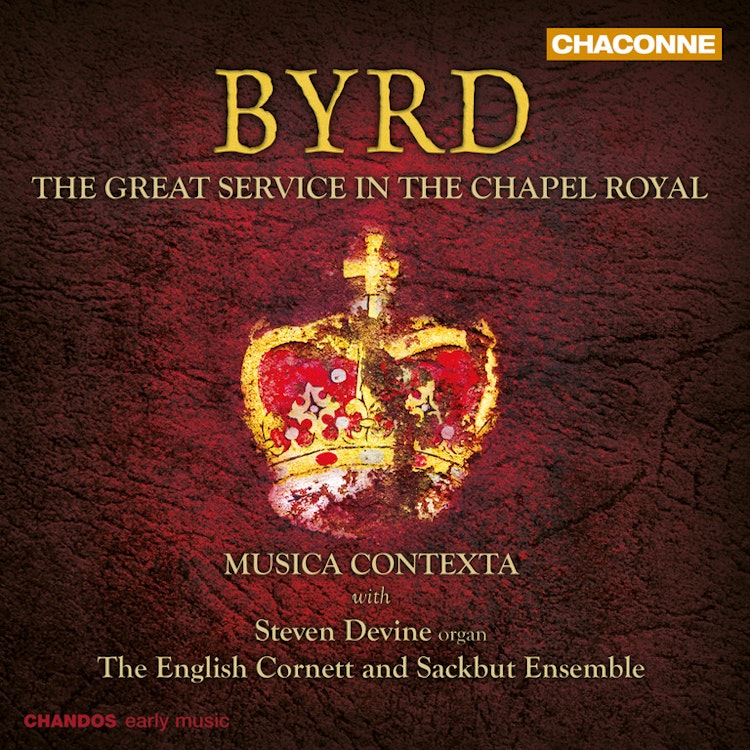
This recording uses Latin motets from Byrd's 1607 Gradualia as instrumental preludes to the Anglican services, a practice that aligns with Byrd's known 'covert activities' as a Catholic.
Composition History
William Byrd's Great Service was likely composed between 1597 and 1604, though its exact purpose or occasion is not definitively known.
Composer Biography
William Byrd, a devout Catholic, was employed by the Anglican Church for most of his life, and his Chapel Royal environment was remarkably sympathetic to Catholics.
Compositional Technique
Byrd's Great Service features two five-part choirs positioned to face each other, creating a kaleidoscopic character through varied combinations of full choir and solo 'verse' sections.
Recording & Production
The Chandos recording uses 24-bit/96 kHz technology, which offers a dynamic range up to 48 dB greater and 256 times the resolution of standard 16-bit recordings.
Instruments
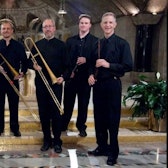
The English Cornett and Sackbut Ensemble performs on period instruments, including cornetts by Matthew Jennejohn and Paolo Fanciullacci, and Renaissance-style sackbuts by Egger and Frank Tomes.
Composer's Artistic Vision
Byrd freely chose to set religious English texts to music, indicating inspiration rather than obligation, and suggesting his religious views were not limited to one direction.
You might also enjoy...
Es kommt ein Schiff geladen
Es kommt ein Schiff geladen
Easter on Fifth Avenue
Sing We Noel
Liebesweisen: Geistliche und weltliche Bekenntnisse