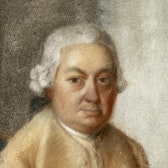
C.P.E. Bach, unlike his legendary organist father J.S. Bach, confessed in 1772 that he had 'lost the use of the pedals' and was not a virtuoso organist.
Composition History
The Wq. 70 set of organ sonatas by C.P.E. Bach were written for Princess Anna Amalia of Prussia, sister to Frederick II 'Frederick the Great'.
Historical Context
Princess Anna Amalia of Prussia, for whom these sonatas were written, was a prominent patroness of the arts and employed Johann Philipp Kirnberger to teach her composition.
Critical Reception
Despite Princess Anna Amalia's apparent dislike of Wq. 70, C.P.E. Bach's organ music is now considered exquisite, combining 'the deepest secrets of art with everything that taste treasures'.
Performer Biography
Iain Quinn, the organist on this recording, was born in Cardiff and studied at The Juilliard School and Yale Institute of Sacred Music before completing a PhD in historical musicology.
Instruments
In 1755, Princess Anna Amalia had a new organ built with a wider range of stops adapted to the latest compositional trends, particularly the 'sensitive' style.
Compositional Technique
C.P.E. Bach's style in these organ works is expressive and fluid, often hiding the melody with ornamentation, flourishes, and unexpected rhythms.
You might also enjoy...
Bach: Orgelwerke auf Silbermannorgeln 4
J.S. Bach: Toccata and Fugue
Handel: Organ Works
Barocco da Sud a Nord
Virgil Fox at Carnegie Hall, New York City, December 20, 1972
Bach-Vivaldi : Concertos
J.S. Bach: The Complete Works for Keyboard, Vol. 5, "Toccata & Weimar 1708-1717"