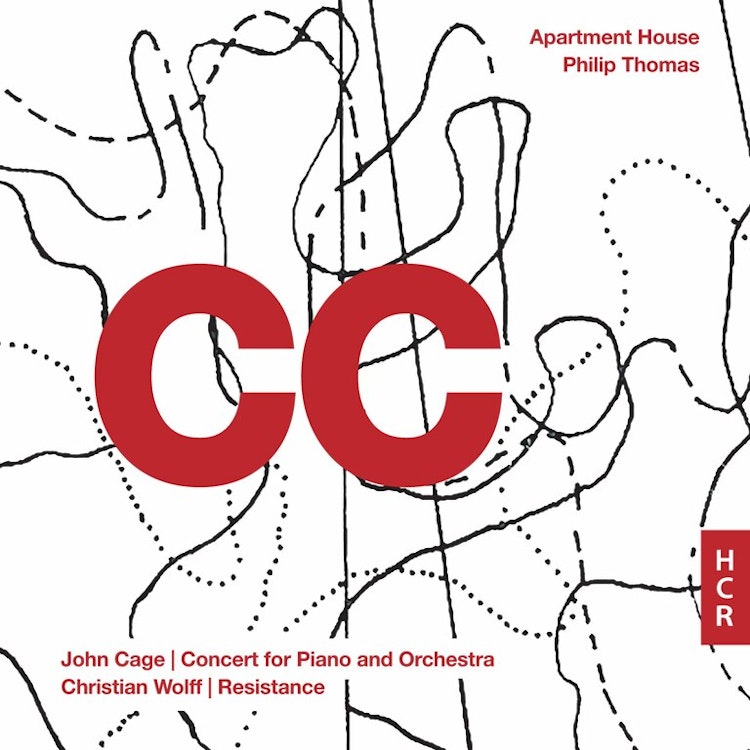
Cage: Concert for Piano & Orchestra - Wolff: Resistance
11/17/2017, 2 Tracks, 1:37:38
Featuring
Jack Sheen
Philip Thomas
Apartment House
John Cage
Christian Wolff
Did you know?
1/7
Compositional Technique
John Cage's Concert for Piano and Orchestra (1957-58) is a seminal example of musical indeterminacy, lacking a score and instead using parts for up to fourteen instrumentalists and a conductor.
Composition History
Christian Wolff's Resistance (2017) was commissioned by Apartment House, the ensemble on this recording, to be premiered alongside Cage's Concert for Piano and Orchestra.
Composer's Artistic Vision
John Cage, the composer, once told trombonist Frank Rehak that performers could get paid for showing up to a gig without playing, if that's what they wanted to do.
Recording & Production
This recording was made possible by an Arts and Humanities Research Council (AHRC) grant as part of a project on John Cage and his Concert for Piano and Orchestra, with additional funding from the Hinrichsen Foundation.
Compositional Technique
The Solo for Piano part in Cage's Concert is a compendium of 84 different notations across 63 pages, some new and some variations of earlier works, requiring imaginative responses from the pianist.
Cultural Impact
Christian Wolff's Resistance (2017) includes musical quotes from Cornelius Cardew's Revolution is the Main Trend and Pete Seeger's song Hold the Line, written about an attempt to disrupt a Paul Robeson concert.
Compositional Technique
Christian Wolff's Resistance (2017) is a collection of notational types, similar to Cage's Solo for Piano, that dictate what, how, and when to play, and with whom.