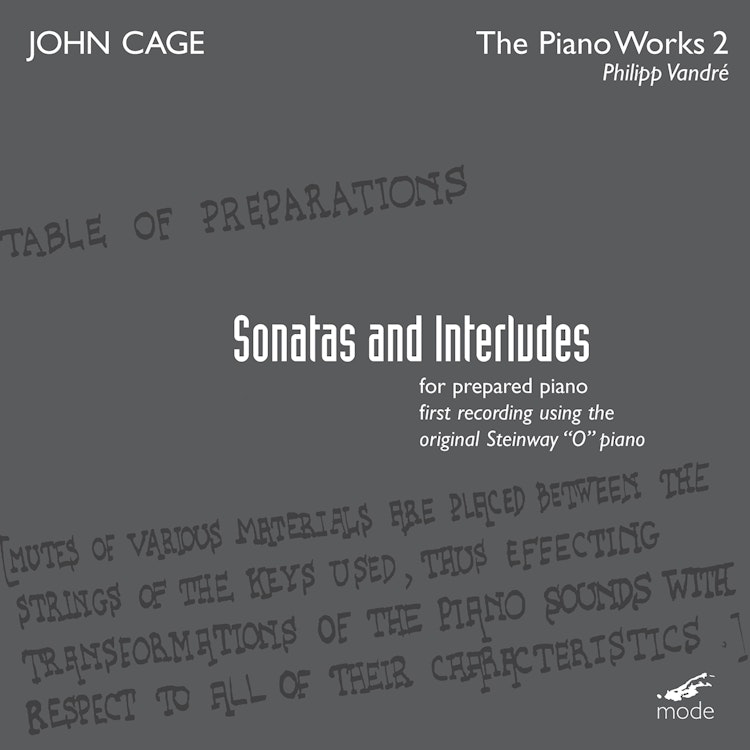
This recording of the Sonatas and Interludes uses an original Steinway Model 'O' baby grand piano, as John Cage originally composed the work for this specific instrument.
Compositional Technique
John Cage's Sonatas and Interludes are written for a prepared piano, an instrument that alters sounds by attaching objects to its strings, making them quieter.
Composer's Artistic Vision
John Cage constructed the Sonatas and Interludes based on the timeless foundation of Hindu aesthetics, allowing each piece to be perfect and unhurried.
Composition History
John Cage began writing the Sonatas and Interludes after a remark from Edwin Denby, a poet and dance critic, that short pieces could be as substantial as long ones.
Composer's Artistic Vision
The content of the Sonatas and Interludes draws upon the Hindu aesthetic theory of rasa, which translates to 'emotional character' and includes eight moods plus Tranquillity.
Historical Context
Peggy Glanville-Hicks, a critic, described John Cage as an experimentalist, noting his fascination with the dramatic power of the pause and the emergence of his prepared piano from this need.
Performer Biography
Philipp Vandré, the performer on this recording, studied music theory with Sergiu Celebidache at Johannes Gutenberg University in Mainz and worked for many years with composer Hans Otte.
You might also enjoy...
Cage: Sonatas and Interludes for Prepared Piano
Berio: Sonata for Piano Solo
Mr John Cage's Prepared Piano - Sonatas & Interludes
Charles Ives: Piano Sonata No. 2 "Concord, Mass., 1840-1860"
Cage: Sonatas & Interludes for Prepared Piano
Cage: Sonatas & Interludes
Balakirev: Complete Piano Works, Vol. 1
John Cage: Sonatas and Interludes
Medtner: Piano Music Vol. 2
Barraqué: Sonate Pour Piano
John Cage: Sonatas & Interludes for Prepared Piano