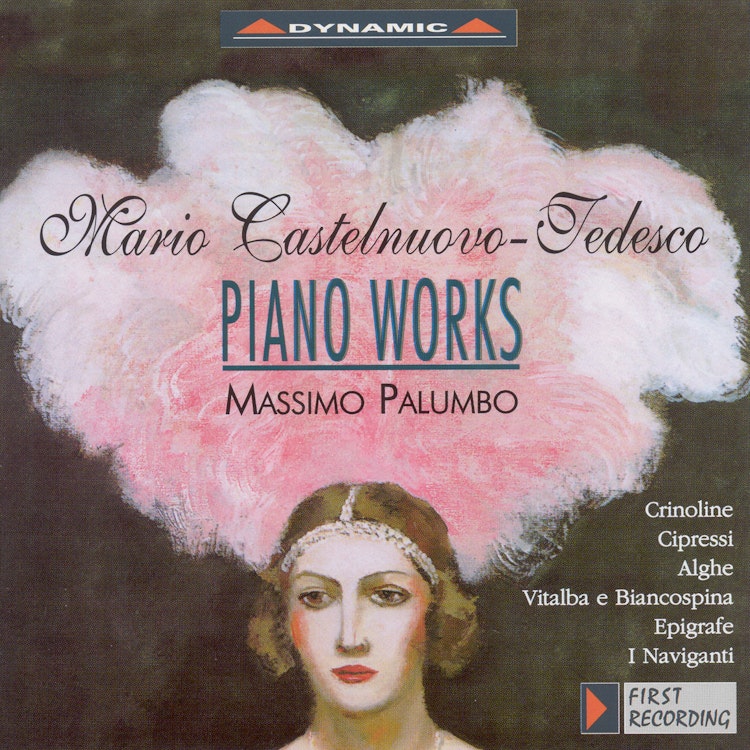
The piece "Epigrafe Op.25" is dedicated "for the grave of Madonna Ilaria Del Carretto sculptured by Jacopo della Quercia, which is in Lucca," and is accompanied by an epitaph from English Renaissance poet Ben Jonson.
Compositional Technique
The piece "Vitalba e Biancospina, fiaba silvana Op.21" includes an extraordinary effect at its end by quoting a popular song from Versilia, "E come debbo far a andarla a ritrovare?".
Composition History
The piano works on this album were composed between 1919 and 1929, representing a period of the composer's most successful artistic creativity.
Compositional Technique
The piece "Alghe Op.12" is part of a trilogy of "Pezzi marini" (Sea Pieces) and shows strong influences from French Impressionist piano models.
Composer Biography
Mario Castelnuovo-Tedesco, born in Florence in 1895, studied piano with Valle de Paz and composition with Ildebrando Pizzetti at the Conservatory.
Composer Biography
Castelnuovo-Tedesco was forced to leave Italy for the United States in 1939 due to his Jewish origins, settling first in New York and then Los Angeles.
Composer Biography
In 1946, Mario Castelnuovo-Tedesco became an American citizen and a teacher at the Los Angeles Conservatory, though he frequently returned to Tuscany for summer holidays.
You might also enjoy...
Ennio Morricone: Piano Music
Falla, M.: El Amor Brujo / 4 Piezas Españolas / El Sombrero De 3 Picos / Fantasia Baetica / Homenaje / Pour Le Tombeau De Paul Dukas
Malipiero: Piano Works
Grainger: Grainger Edition, Vol. 19: Works for Solo Piano, Vol. 3
Crawford -9 Preludes (Cahill)
Aperghis: Works for Piano
Grainger, P.: Piano Music (Complete)
Mompou: Piano Music - Discoveries
Mompou: The Piano Music, Vol. 2
Charles Tomlinson Griffes: Piano Music
Œuvres pour la main gauche - Anthologie, Vol. 9 - 7ème Art