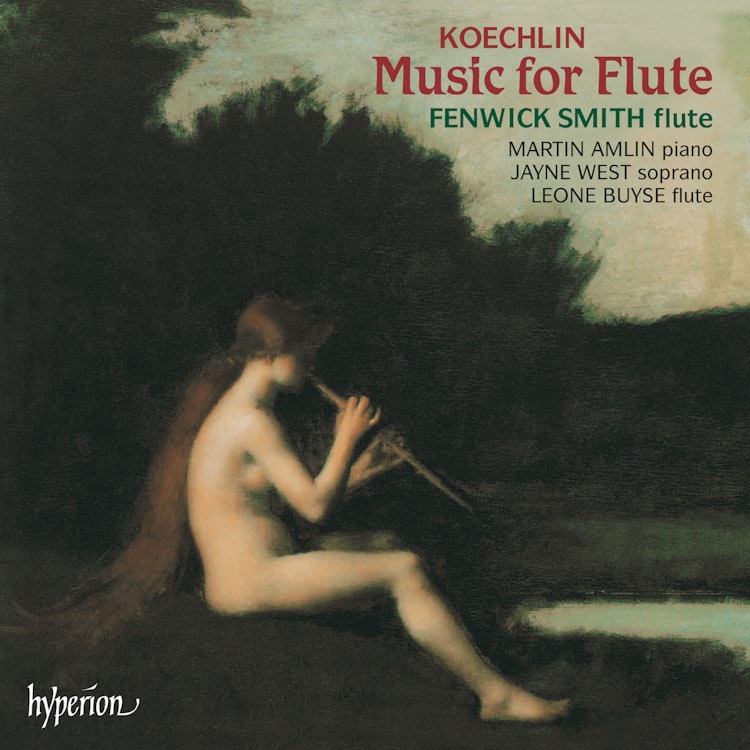
Koechlin dedicated two entire albums, Op. 139 and Op. 149, to Lilian Harvey, a film idol who, unfortunately, was largely uninterested in his efforts.
Compositional Technique
One piece, 'Le voyage chimérique' ('The Dream Voyage'), sketches an imaginary trip to Hollywood, complete with a train flying over rooftops, plunging into the ocean, crossing Arizona, and arriving in California with a grandiose paraphrase of 'The Star-Spangled Banner'.
Compositional Technique
Koechlin's musical culture was broad, encompassing styles from Gregorian chant to the new Viennese school, allowing him to write in diverse and seemingly incompatible styles while maintaining his unique voice.
Recording & Production
This recording includes the first-ever recordings of Koechlin's Sonata for piano and flute, Op. 52, L'Album de Lilian, Op. 139 and Op. 149, and Morceau de lecture, Op. 218.
Performer Biography
Fenwick Smith, the flutist on this recording, is a member of the Boston Symphony Orchestra and built the Powell flute he plays himself, having worked as a flutemaker for ten years.
Composer's Artistic Vision
Charles Koechlin, the composer, was fascinated by the "insolent beauty" of early sound film stars, particularly Lilian Harvey, which inspired several of his works.
Compositional Technique
The 'Pleurs' ('Tears') movement from L'Album de Lilian, Op. 139, features angular, hyperchromatic sequences and a shrieking piccolo, suggesting an unexpected influence from Schoenberg's Pierrot Lunaire.
You might also enjoy...
Luftpost aus Wien
Luminance
The Complete Musical Heritage Society Recordings
Schocker, G.: For Dad / Poulenc, F.: Flute Sonata / Hindemith, P.: Flute Sonata
Undine
French Works for Flute
Franck, Fauré & Prokofiev: Works for Flute & Piano
Poulenc, Fauré & Debussy: Impressions françaises
Flute Recital: Bailey, Don - Muczynski, R. / Boulanger, L. / Ravel, M. / Poulenc, F. / Martinu, B. / Hoover, K. / Gieseking, W.
The Girl with the Flaxen Hair
Schubert, F.: Lieder (Arr. for Flute and Piano)
„Der meint‘es treu!“: Music for Fortepiano & Winds from the Biedermeier Salon