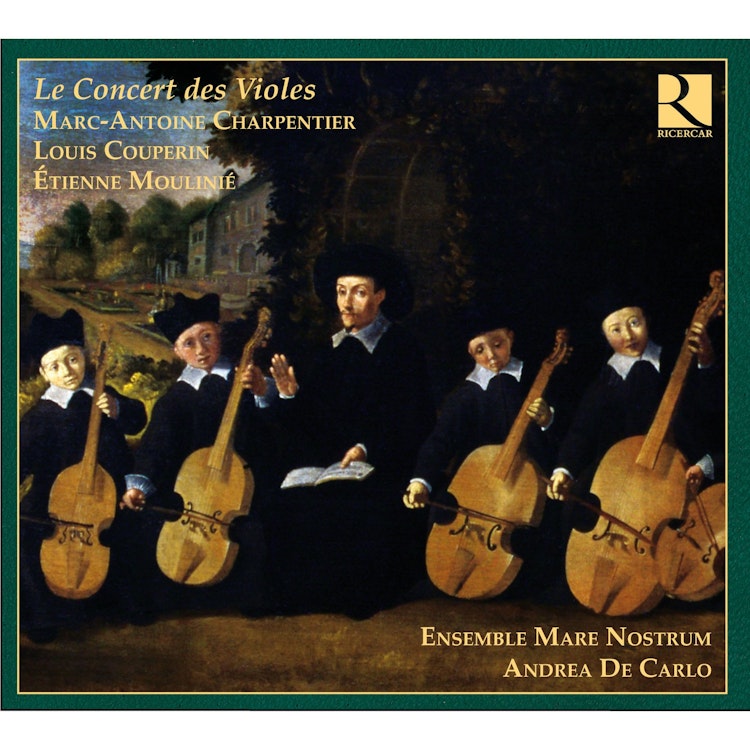
Charpentier, Couperin & Moulinié: Le Concert des Violes
12/3/2009, 17 Tracks, 59:07
Featuring
Andrea De Carlo
Ensemble Mare Nostrum
Louis Couperin
Eustache Du Caurroy
Claude Le Jeune
Estienne Du Tertre
Étienne Moulinié
Henri Dumont
François Roberday
Marc-Antoine Charpentier
Did you know?
1/7
Composer Biography
Louis Couperin, a prominent organist, was offered a new position as 'dessus de viole' (treble viol player) by the King after he declined to usurp his benefactor's harpsichordist role.
Historical Context
The French court's musical institutions, such as the XXIV violins and La Chambre du Roi, were highly compartmentalized, each with its own specific function and instrumentation.
Interpretation
For several of Louis Couperin's 'Simphonie' or 'Fantaisie' pieces, the inner polyphonic parts were completed by Leonardo García Alarcón, as only the dessus and bass lines survived.
Composition History
This album presents an anthology of French viol ensemble repertoire from the late 16th century to Marc Antoine Charpentier's Concert pour quatre parties de violes (1680-1681), considered the last composition for such a group.
Compositional Technique
François Roberday's Fugues et Caprices for organ (1660) were published on four staves, making them easily adaptable for performance by viol ensembles, with each player having a separate part.
Historical Context
In France, from the late 16th to mid-17th century, the roles of viols and violins were distinct: violins for dance music and viols for polyphonic chamber music.
Compositional Technique
Marc Antoine Charpentier's Concert pour quatre Parties de Violes (1680-1681) is identified as being for viols by the use of the G clef on the second line for the dessus part, unlike his other works for violin or flute.
You might also enjoy...
Æternum: Music of the Elizabethan Avant Garde from Add. MS 31390
Bigaglia: VII Sonate per flauto dolce e basso continuo
Albinoni: Sinfonie a cinque, Op. 2 (Alpha Collection)
Le trésor d'Orphée
Paisible: 6 Setts of Aires
Lawes: Fantasia-Suites for Two Violins, Bass Viol & Organ
Bononcini: Divertimenti da camera, Transcription for Harpsichord