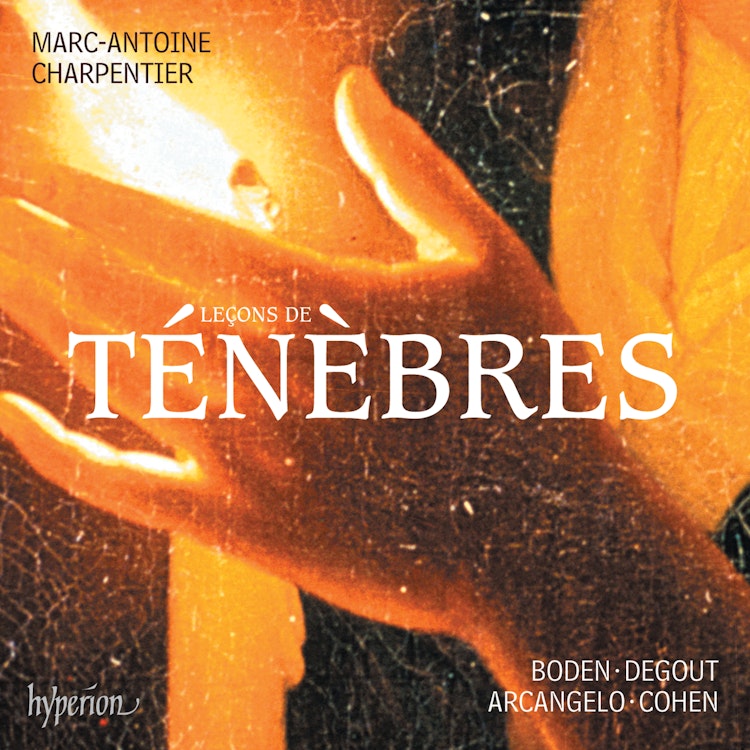
Charpentier: Leçons de ténèbres, Litanies & Magnificat
7/28/2023, 30 Tracks, 1:13:34
Featuring
Jonathan Cohen
Stéphane Degout
Samuel Boden
Arcangelo
Marc-Antoine Charpentier
Did you know?
1/7
Composer Biography
Charpentier never secured a position at Louis XIV's court or the Paris Opéra, partly due to his rival Jean-Baptiste Lully.
Composer Biography
Marc-Antoine Charpentier studied in Rome with Giacomo Carissimi at the Jesuit Collegium Germanicum in the late 1660s.
Performer Biography
Samuel Boden, a tenor on this recording, originally trained and worked as a chef before changing his career path to study singing.
Composition History
Charpentier's Litanies de la vierge, H83, was written for Mademoiselle de Guise, a patron whose birthday fell on the Feast of the Assumption of the Virgin.
Historical Context
The Tenebrae services, which involve the gradual extinguishing of candles, were popular in 17th and early 18th-century France, with Charpentier composing 53 settings.
Composer's Artistic Vision
Charpentier's compositional style fused mid-century Italian and French styles, a 'diversity' he himself noted in his treatise Règles de composition.
Compositional Technique
Charpentier's Magnificat à 3, H73, uses a descending four-note ostinato (G-F-E flat-D) in the bass, reminiscent of Monteverdi's L'incoronazione di Poppea.
You might also enjoy...
Purcell: Ode For St. Cecilia's Day; My Beloved Spake; O Sing Unto The Lord
Love Songs & Psalms
Vivaldi: Stabat mater; Nisi Dominus; Salve Regina
Monteverdi: Testamento. Vespro della Madonna 1643
Charpentier: Messe à quatre chœurs - Carnets de voyage d'Italie
Monteverdi: Missa da cappella a sei voci “In illo tempore" & Messa a quattro voci da cappella