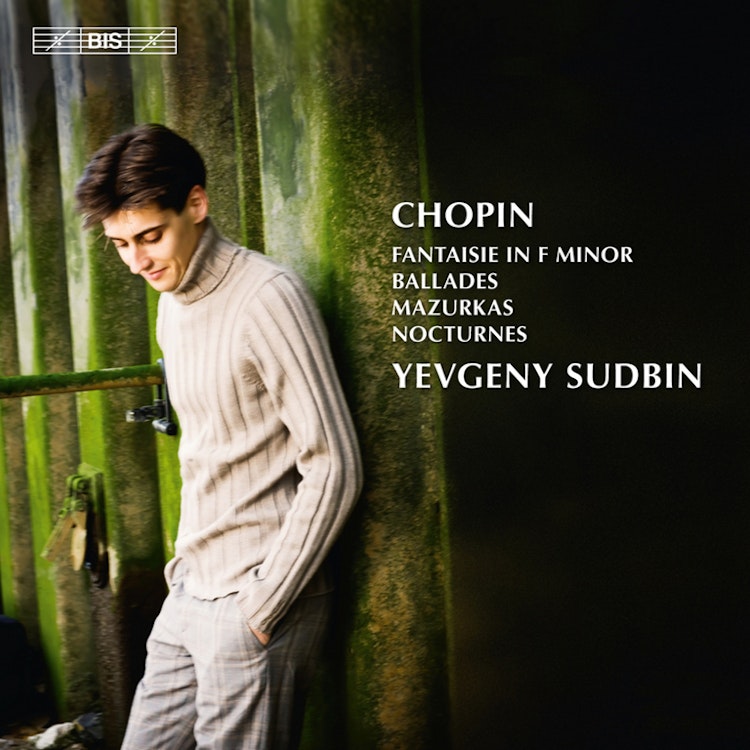
Chopin: Fantaisie in F minor - Ballades - Mazurkas - Nocturnes
10/4/2011, 12 Tracks, 1:09:48
Featuring
Yevgeny Sudbin
Frédéric Chopin
Did you know?
1/7
Composer's Artistic Vision
Chopin believed that 'simplicity is the highest goal, achievable when you have overcome all difficulties,' emerging as the crowning reward of art after playing many notes.
Composer Biography
Chopin's relationship with the piano was so profound that he called the instrument his 'second self,' and playing it seemed more natural to him than speaking or breathing.
Performer Biography
Yevgeny Sudbin, the pianist on this album, was born in St Petersburg and has been hailed as 'one of the most important pianistic talents of our time' by International Record Review.
Compositional Technique
The Fantaisie in F minor, Op. 49, is improvisatory in style, free from rigid forms, and full of contrasts, notably starting in F minor and ending in A flat major.
Compositional Technique
Chopin's mazurkas, while originating from a Polish folk dance, use only the rhythms as a starting point to create independent musical worlds of his own invention.
Critical Reception
Chopin's Ballade No. 4 in F minor was initially regarded as inaccessible by 19th and early 20th-century critics, who complained about 'ear-splitting discords' and 'harsh modulations,' but is now considered a masterpiece.
Recording & Production
This album was recorded in February 2009, July 2010, and January 2011 at St George's Bristol, England, using Neumann microphones and a 5.0 surround sound configuration.
You might also enjoy...
Chopin in Mallorca
Schubert, Chopin & Liszt: Art of the Encore
Piano Recital: Cherkassky, Shura - Schubert, F. / Chopin, F. / Liszt, F. (Art of the Encore)
2nd Chopin Festival Hamburg 2019 (Live)
Chopin X Chopin (Live)
Schubert: Piano Sonata in B-Flat Major, D. 960
Chopin: Complete Solo Piano Works in Opus Order, Vol. 8