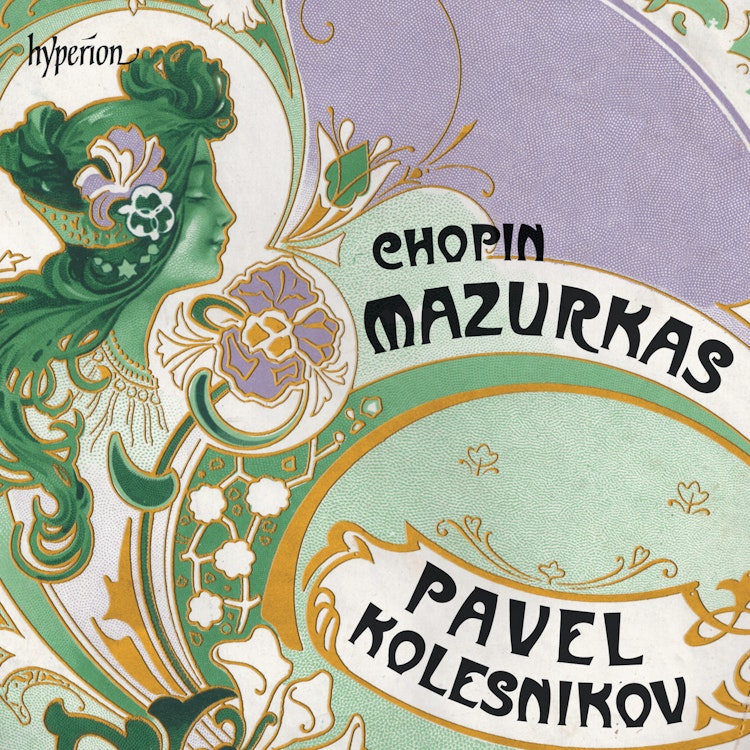
Chopin sketched the E minor Mazurka from Op 41 while visiting Majorca during the early days of his relationship with the famous writer George Sand.
Composer's Artistic Vision
Chopin did not merely imitate a Polish sound in his mazurkas; he created this sound, offering a musical image of Poland to a wider European audience.
Composition History
The Mazurka in A minor, Op 68 No 2, was published posthumously by Chopin's amanuensis Julian Fontana, who dated its composition to 1827.
Composer's Artistic Vision
The mazurka was a crucial genre for Chopin, serving as a 'laboratory' for harmonic, rhythmic, textural, and formal experimentation, all to create a musical image of his native Poland.
Compositional Technique
Chopin's mazurkas often feature 'rubato' (rhythmic dislocation) and a three-part design with a contrasting central section, which became key markers for the genre.
Composition History
Chopin typically published his mazurkas in groups of three or four, with the concluding number often being the longest and most complex, suggesting a planned overall sense for the opus.
Composer Biography
In his later style, Chopin returned to studying formal counterpoint, which influenced works like the C sharp minor Mazurka, Op 50 No 3, where he merged the sound world of J.S. Bach with his imaginary Poland.
You might also enjoy...
The Koroliov Series, Vol. 11
Chopin: Mazurkas
Chopin Mazurkas - Ronan Magill Vol.1
Chopin: Mazurkas, Vol. 1
Chopin: Mazurkas, Op. 24: No. 4 in B-Flat Minor
Szymanowski: Mazurkas, Opp. 50 & 62
17 Mazurkas Composed from 1840 to 1849
23 Mazurkas Composed from 1825 to 1833, Presented in Chronological Order
Grand Piano Masters: Chopin: 3 Mazurkas Opus 50
Chopin: Mazurka in A Minor, Op. 67 No. 4 (From Rothschild Livre d'Or, MS Paris, 28 Nov. 1847)