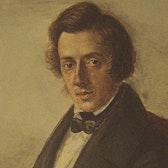
Chopin, as an exile in Paris, expressed his anguish over Poland's oppression by Russia, composing for his homeland after it was crushed.
Composer's Artistic Vision
Chopin conceived his Préludes as a "microcosm of landscapes" and an "intimate journal," enriched by improvisational experiences, rather than a continuation of Bach's fugal tradition.
Composition History
Chopin's 24 Préludes, Op. 28, were largely completed during a difficult three-month stay in a monastery in Valldemossa, Majorca, in 1838-1839.
Composer Biography
Chopin's mother, Justyna, an impoverished relative of Countess Skarbek, played the clavichord for him as a child, an experience perhaps echoed in the Berceuse.
Compositional Technique
Chopin transformed the Polish polonaise dance, moving it away from mere social display to become a symbol of struggle and national sentiment, as seen in his Polonaise Op. 44.
Recording & Production
This album was recorded at the Krzysztof Penderecki European Centre for Music in Lusławice, Poland, a venue known for its supreme acoustic qualities.
Cultural Impact
Chopin's Barcarolle, Op. 60, was greatly admired by later French composers such as Ravel, Debussy, and Fauré.
You might also enjoy...
Fou Ts'ong Plays Chopin Vol. I
Pollini Plays Chopin
Chopin: Complete Solo Piano Works in Opus Order, Vol. 8