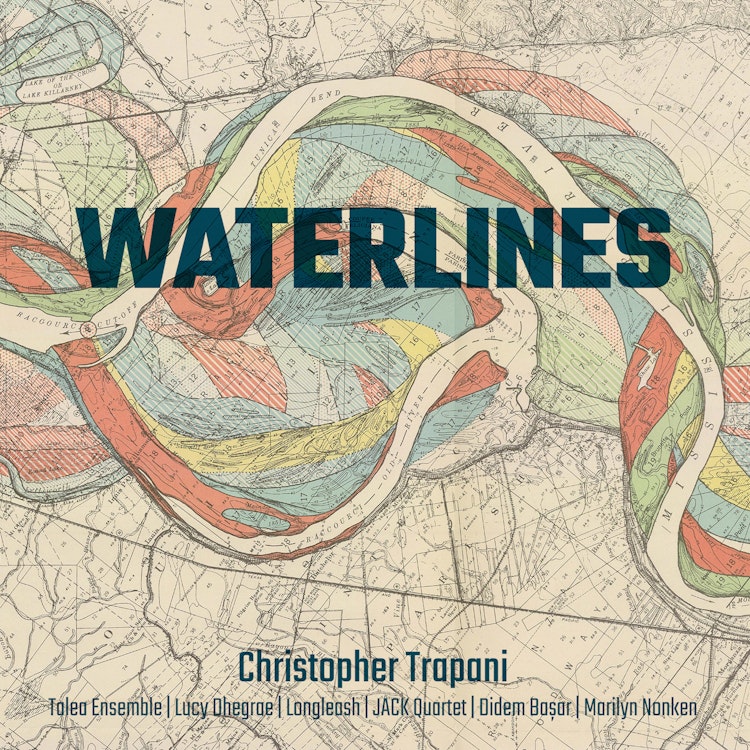
The title of Christopher Trapani's piece Cognitive Consonance is a manifesto for his work, aiming for music that is both 'cognitive' (provoking thought and memory) and 'consonant' (exploring and redefining consonance).
Compositional Technique
Cognitive Consonance features a custom-made qanûn (a trapezoidal zither) designed by Julien Jalâl Eddine Weiss, which allows for fifteen non-equidistant microtonal intervals per string.
Composition History
The album's opening work, Waterlines, was inspired by composer Christopher Trapani's experience watching Hurricane Katrina unfold from Paris, and his subsequent immersion in Delta Blues records about the 1927 Mississippi River flood.
Composer's Artistic Vision
Visions and Revisions, a set of variations, explores 'circular thinking' and memory's intrusive role, constantly returning to basic chords despite attempts to move into more complex harmonic territory.
Composer's Artistic Vision
Christopher Trapani's music blends American and European styles, incorporating elements like Delta Blues, Appalachian folk, and Turkish makam with spectral music.
Compositional Technique
The piece Westering, from Cognitive Consonance, uses a hexaphonic electric guitar, which has a divided pickup sending six separate signals, allowing for independent transposition and microtonal precision for each string.
Composer Biography
Christopher Trapani, the composer, was born in New Orleans and spent his twenties overseas, studying in London, Istanbul, and Paris before returning to New York City.
You might also enjoy...
Gershwin Reimagined: An American In London
Timothy Reynish Live in Concert, Vol. 3
François Rauber: Suites d'orchestre
Koessler: Trio Suite / Piano Quintet in F Major / Moor: Cello Sonata No. 2, Op. 55