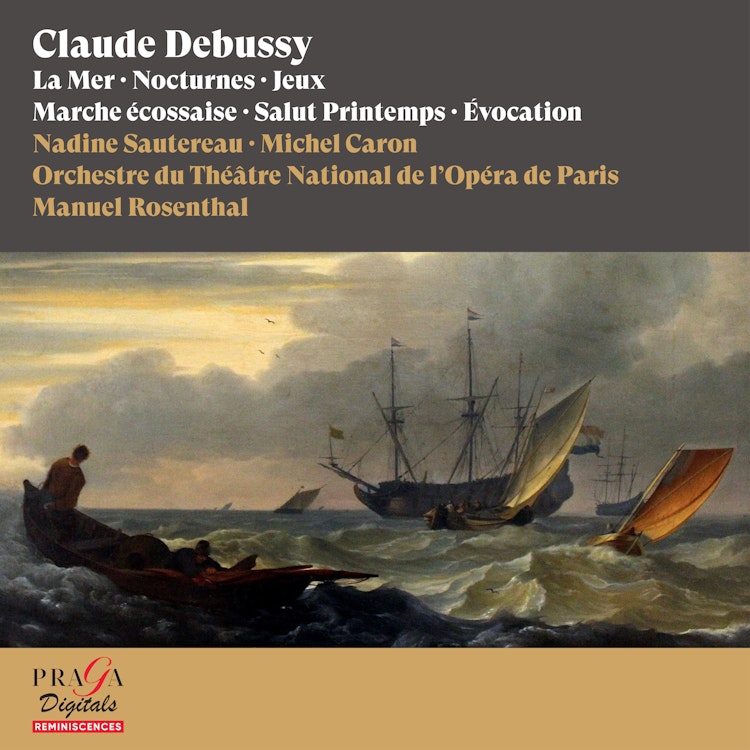
Claude Debussy: La Mer, Nocturnes, Jeux, Marche écossaise, Salut Printemps, Évocation
1/1/2013, 10 Tracks, 1:19:04
Featuring
Manuel Rosenthal
Nadine Sautereau
Michel Caron
Orchestre du Théâtre National de l'Opéra de Paris
Choeur d'enfants de la Radio-Télévision Française
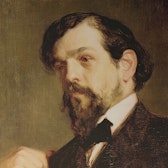
Claude Debussy
Did you know?
1/7
Composer's Artistic Vision
Debussy rejected the term 'impressionist' for his music if it restricted him, preferring the freedom to express himself as a symbolic poet.
Performer Biography
Manuel Rosenthal, the conductor on this album, was one of the rare composition pupils of Maurice Ravel, starting in 1926.
Composer Biography
Claude Debussy, the composer, once claimed that he was destined for a career in the Navy, but chance circumstances led him to music.
Compositional Technique
In the 'Sirènes' movement of Nocturnes, a choir of sixteen female voices sings a single vowel sound, used like an orchestral instrument.
Composition History
Debussy's Jeux, a 'poème dansé', was commissioned by Serge de Diaghilev for the Russian ballet and premiered in Paris in 1913, choreographed by Nijinsky.
Critical Reception
Debussy's Jeux was long considered merely an innocent ballet, but later recognized as a consummate work by figures like Pierre Boulez and French post-serialists.
Compositional Technique
Debussy's La Mer, a symphonic work, abandons classical composition for an organic style of growth, with movements more akin to biology than mathematical structures.
You might also enjoy...
Debussy: La Mer, Prélude à l'après midi d'un faune, Ibéria & Nocturnes
Debussy: La Mer & Prélude à l'après-midi d'un faune
Debussy: La Mer; Images; Prélude à l'après-midi d'un faune
Debussy: Nocturnes; Prélude à l'après-midi d'un faune; La Mer
Debussy: La mer & Nocturnes
Debussy: La Mer; Nocturnes; Prélude à l'après-midi d'un faune
Debussy: La Mer; Images; Prélude à l'après-midi d'un faune