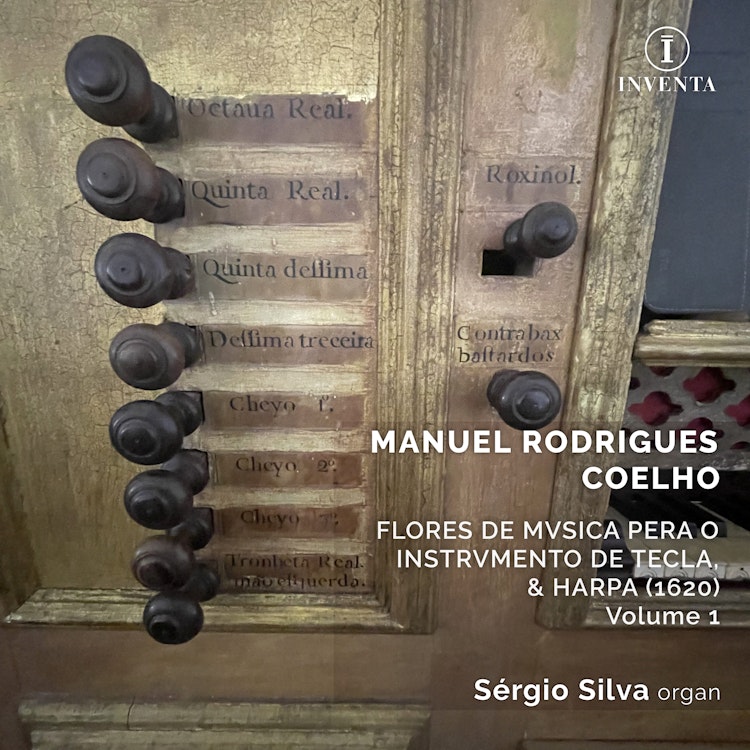
Coelho: Flores de musica pera o instrumento de tecla, & harpa, Volume 1
10/7/2022, 49 Tracks, 1:03:05
Featuring
Maria de Fátima Nunes
Mariana Moldão
Sérgio Silva
Manuel Rodrigues Coelho
Did you know?
1/7
Composition History
Coelho's "Flores de musica pera o instrumento de tecla & harpa" (1620) is his only known work and one of the largest music works printed in the 17th century, spanning over five hundred pages.
Recording & Production
This recording celebrates the 400th anniversary of the original publication of Coelho's "Flores de musica" and is based on a new three-volume edition curated by João Vaz.
Composer Biography
Manuel Rodrigues Coelho, born around 1555 in Elvas, Portugal, served as an organist in his hometown, Badajoz (Spain), and later at the Royal Chapel in Lisbon.
Performer Biography
Sérgio Silva, the organist on this recording, is a teacher at the Instituto Gregoriano de Lisboa and the Escola de Música Sacra de Lisboa, and is the titular organist of two important historical organs in Lisbon.
Interpretation
The recording aims to use all the media prescribed by Coelho, including keyboard instruments (organ, harpsichord, clavichord) and harp, though none of his original instruments survive.
Compositional Technique
Coelho's "Flores de musica" includes numerous liturgical works designed for "alternatim practice," where organ music replaces sung verses in Mass and Office sections.
Instruments
The recording was made in Elvas Cathedral, Portugal, using two organs built by Italian organ builder Pascoal Caetano Oldovini in 1758 and 1762, which are suitable for Coelho's music despite being built later.
You might also enjoy...
Buchner: Plectrum musicum, Op. 4 (Excerpts)
Lagrime
Salvatore: Organ-Alternatim Masses
Pavans & Fancies for the Viols
Carissimi: 8 Motets
Le trésor d'Orphée
Lebègue: Pièces de clavessin
Rameau: Concerts en Sextuor
Marcello, A.: Oboe Concerto in D Minor / Telemann, G.P.: Oboe Concerto in F Minor / Handel, G.F.: Oboe Concerto No. 3