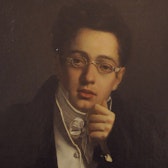
Schubert's early musical training took place at the Vienna Stadtkonvikt, a prestigious boarding school where he trained as a chorister and occasionally conducted the orchestra from his violin chair.
Compositional Technique
Despite composing many short, accessible pieces for the market, Schubert used the four-hand piano format to create a unique sound world, exploring keyboard ranges, tonal shifts, and poetic ornamentation.
Recording & Production
This recording project, which aims to record the entirety of Schubert's four-hand works, is a rare achievement in discography and a long-term ambition for the Geister Duo.
Composition History
Schubert's works for piano four-hands were his most published genre during his lifetime, reflecting their popularity in Viennese society.
Cultural Impact
Schubert's social gatherings, where he unveiled new works to friends, were immortalized as 'Schubertiades', painting a picture of him as a communal musician rather than a solitary figure.
Composer's Artistic Vision
Franz Schubert, unlike Beethoven who wrote for posterity, composed for his present, with his circle of friends forming his primary audience.
Performer Biography
The Geister Duo, comprised of David Salmon and Manuel Vieillard, has won multiple prestigious awards, including the first prize at the ARD Munich International Competition in 2021.
You might also enjoy...
Piano Recital: Yun-Yi Qin - Mozart, W.A. / Schubert, F. / Haydn, J. / Granados, E. / Scriabin, A. / Friedman, I. / Liszt, F. / Prieto, C.
Essenz
Scandale
2025 Cliburn Competition: Alice Burla – Preliminary Round (Live)
Piano Duets
Four Square
J. Andrychowicz, Emilia Potocka, Józefina Wejnert, Maria Szymanowska: Piano Works
Mozart, Schubert, Friedman & Stravinsky: Works for 4 Hands
Once Upon a Time
Ehrenfried, Mark: Bach / Mozart / Haydn / Beethoven / Schubert / Mendelssohn / Tchaikovsky