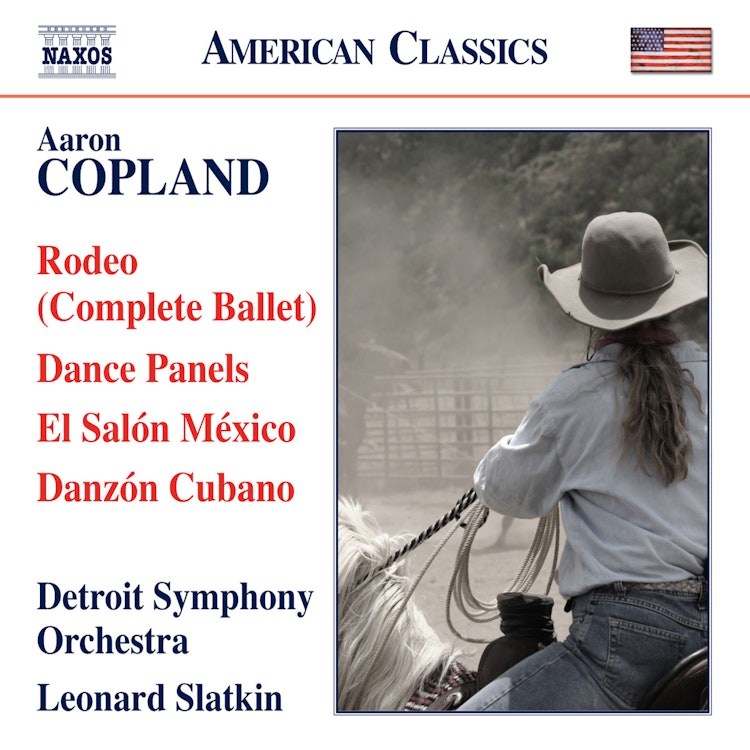
Copland: Rodeo, Dance Panels, El Salón México & Danzón Cubano
12/4/2013, 14 Tracks, 1:10:11
Featuring
Leonard Slatkin
Detroit Symphony Orchestra
Aaron Copland
Did you know?
1/7
Composer's Artistic Vision
Copland created a uniquely American sound in his ballets by using indigenous rhythms and songs, along with wide open harmonies suggesting the American West.
Composer Biography
Aaron Copland produced three ballet scores between 1938 and 1944 that established him as a vital voice in 20th-century American music.
Compositional Technique
In Danzón Cubano, Copland used authentic Cuban dance rhythms, specifically the Danzón, which he described as a stately dance similar to a waltz.
Composition History
The ballet Rodeo was commissioned by the Ballet Russe de Monte Carlo, a company with a classical European repertoire that had moved to the U.S. during World War II.
Performer Biography
Leonard Slatkin, the conductor on this album, has received seven GRAMMY® Awards and 64 GRAMMY® Award nominations for his more than 100 recordings.
Composition History
Copland's ballet Dance Panels was originally conceived as a full-length ballet without a story, based on a series of dances, mainly waltzes.
Composer's Artistic Vision
For El Salón México, Copland aimed to reflect the 'Mexico of the tourists' and capture the spirit of the Mexican people he encountered in a dance hall.
You might also enjoy...
Respighi: Transcriptions for Orchestra
Jeffes: "Still Life" at the Penguin Café; Four Pieces for Orchestra
Markevitch, I.: Complete Orchestral Works, Vol. 4
Bliss: Miracle in the Gorbals, F. 6 & Metamorphic Variations, F. 122
Markevitch: Orchestral Music, Vol. 3 - Rebus / Hymnes
Markevitch: Orchestral Music, Vol. 3 - Rebus / Hymnes
Dukas: Der Zauberlehrling - Saint-Saëns: Totentanz - Milhaud: Die Erschaffung der Welt - Enescu: Rumänische Rhapsodie No. 1 - De Falla: Feuertanz
Stravinsky: Rite of Spring, Firebird Suite, Scherzo, Tango
Poulenc: Les Biches / Ibert: Divertissement / Milhaud: Le Boeuf Sur Le Toit
Copland: Rodeo/El Salón Mexico/Billy the Kid/Danzón Cubano
Stravinsky: The Firebird & Fireworks
Poulenc, F.: Animaux Modeles Suite (Les) / Sinfonietta
Stravinsky: Agon - Schuller: Seven Studies on Themes of Paul Klee