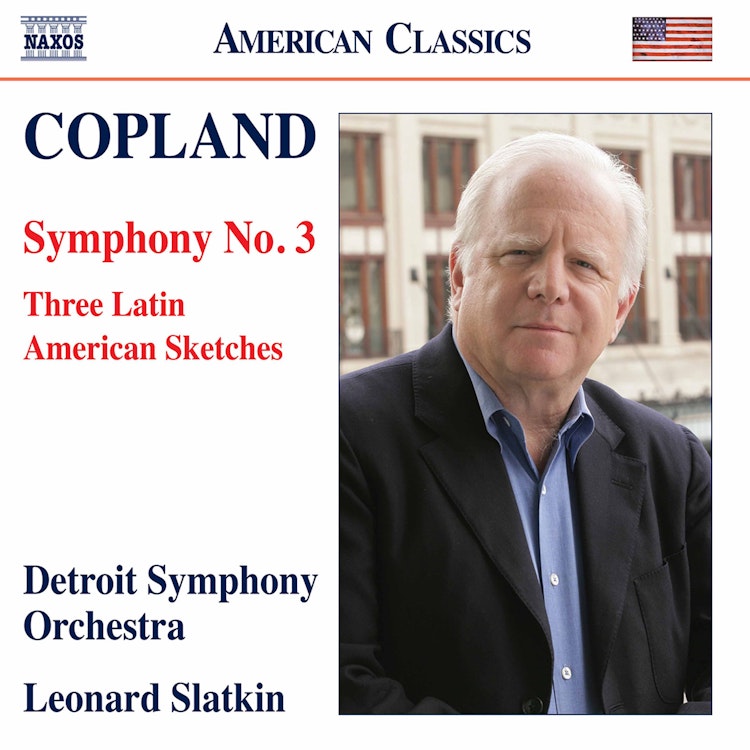
Copland: Symphony No. 3 & 3 Latin American Sketches
6/9/2017, 7 Tracks, 55:13
Featuring
Leonard Slatkin
Detroit Symphony Orchestra
Aaron Copland
Did you know?
1/7
Historical Context
Copland wrote Fanfare for the Common Man in 1943, deciding on the title because he felt the common man was "doing all the dirty work in the war" and deserved dedication.
Composition History
Aaron Copland's Symphony No. 3 was premiered in October 1946, a year after World War II ended.
Composer's Artistic Vision
Copland described his Symphony No. 3 as an "end-of-war piece" intended to reflect the euphoric spirit of the country at the time.
Composer Biography
Copland developed a love for Latin-American music after visiting the nightclub El Salón México in 1932 with composer/conductor Carlos Chávez.
Performer Biography
Leonard Slatkin, the conductor on this album, has garnered seven GRAMMY® awards and 64 nominations for his more than 100 recordings.
Compositional Technique
The finale of Copland's Symphony No. 3 opens by quoting his well-known piece, Fanfare for the Common Man, first quietly in the winds, then forcefully in the brass.
Interpretation
This recording of Copland's Symphony No. 3 uses the original version, which includes an elongated coda that adds a broader and richer sound.
You might also enjoy...
Copland: Symphony No. 3; Quiet City
Norman Dello Joio: Homage to Haydn & The Triumph of Saint Joan Symphony
Leighton: Cello Concerto & Symphony No. 3
Elliott Carter Premieres: Symphony No. 1, Variations for Orchestra
Ives: Symphony No. 3, "The Camp Meeting" / Orchestral Set No. 2
The Copland Collection: Early Orchestral Works (CD #1: 1923 - 1928 & CD #2: 1929 - 1935)
Mason Bates: Works for Orchestra
Leonard Bernstein Conducts Ives (Remastered)
Dvorak: Symphony No. 9 "From the New World"
Hovhaness: Symphonies Nos. 1, 'Exile Symphony' and 50, 'Mount St. Helen'