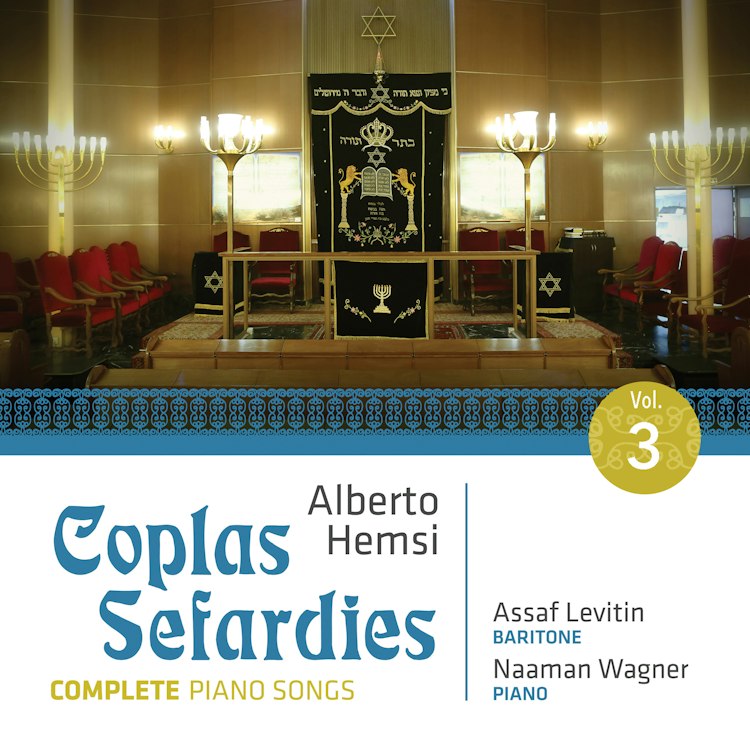
Assaf Levitin, the baritone on this album, wrote his Master's thesis on Alberto Hemsi's liturgical music and has served as Master of Music in synagogues in Alexandria and Paris.
Composition History
Hemsi's research into Judeo-Spanish folklore began in 1919 when a chance encounter in his hometown revealed its original elements.
Cultural Impact
A Madrid musicologist, José Subirà, encouraged Hemsi's work, believing it would be recognized as a 'missing link' between traditional Spanish music and Sephardic music.
Composer Biography
Alberto Hemsi, the composer, was born in Cassaba, Asiatic Turkey, and his parents were also born and lived there.
Compositional Technique
Hemsi's 'Coplas Sefardies' incorporate unusual rhythms like 5/8, 7/8, or 9/8, and patterns such as 5+7=12, which are characteristic of Middle Eastern music theory called 'Dor' and result in 'Aksak' rhythms.
Composer's Artistic Vision
Hemsi aimed to create symphonic soundscapes for his piano parts, not just simple accompaniments, to evoke the ambiance, mood, subject, and melody of the songs.
Historical Context
Hemsi's ancestors were among those exiled from Spain in 1492 by the Catholic Kings Ferdinand and Isabella, forming the Judeo-Spanish traditional folklore he later studied.
You might also enjoy...
Glinka: A Farewell to Saint Petersburg (Live)
Licht
Shostakovich: Romances & Monologues
Songs of Wintter Watts
Křička: Three Fables, Op. 21 I. O neposlušných kozlatech (The tale of the disobedient kid goats)
Friedrich Wilhelm Kücken: Romantische Lieder - Romantic Songs: Das Wasser ist tief, Op. 78