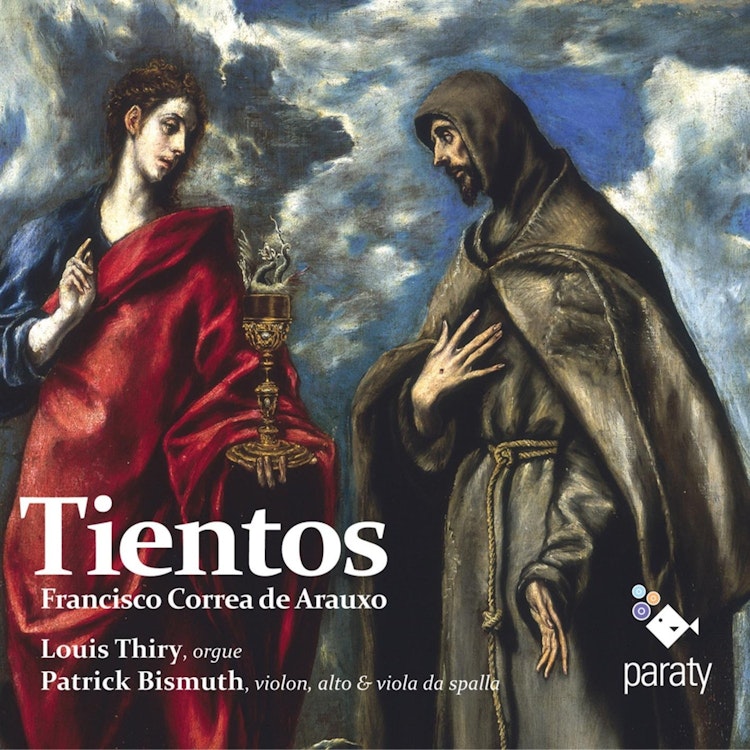
Correa De Arauxo: Tientos (Y Discursos De Música Práctica Y Theórica De Órgano Intitulado Facultad Orgánica)
4/18/2012, 10 Tracks, 53:23
Featuring
Patrick Bismuth
Louis Thiry
Francisco Correa de Arauxo
Did you know?
1/7
Interpretation
The performers chose to transcribe these organ works for violin, viola, and viola da spalla, believing that transcription has always been important in the evolution of music.
Performer Biography
Patrick Bismuth, who performs violin, viola, and viola da spalla on this recording, incorporates improvisation, folk traditions, and gypsy music into his artistry alongside Western classical music.
Compositional Technique
The tiento, a musical form explored by Correa de Arauxo, is characterized by its experimental nature, allowing for exploration of sounds and new musical paths.
Composition History
Correa de Arauxo's only known surviving work is the Libro de tientos y discursos de música práctica y theórica de órgano intitulado Facultad orgánica, published in 1626.
Composer's Artistic Vision
Correa de Arauxo's 1626 book is both a collection of organ pieces and a theoretical work, including a long preface on topics like fingering, touch, and virtuosity.
Instruments
Many of Correa de Arauxo's tientos are 'de medio registro', referring to a 17th-century Iberian organ characteristic where the single keyboard was divided at middle C into two independent registers.
Composer Biography
Francisco Correa de Arauxo, one of the greatest Spanish organists of the 17th century, was likely of Portuguese origin and is a distinguished representative of Spain's 'Golden Age'.
You might also enjoy...
Frescobaldi: Il Primo Libro delle Fantasie a quattro
J.S. Bach: The Art of Fugue
Frescobaldi: Il primo libro di capricci
Czerny: Organ Music
Frescobaldi: Recercari & Canzoni Franzese fatte sopra diversi oblighi in partitura
Bach: The Trio Sonatas
Bach: Trio Sonatas for Organ BWV 525-530
L'Organo in Europa fra Rinascimento e Barocco
Bach, J.S.: Heyday in Weimar
Jesu, meine freude: Church Service Music of Toyama Kashimacho Church - Passion & Ressurection