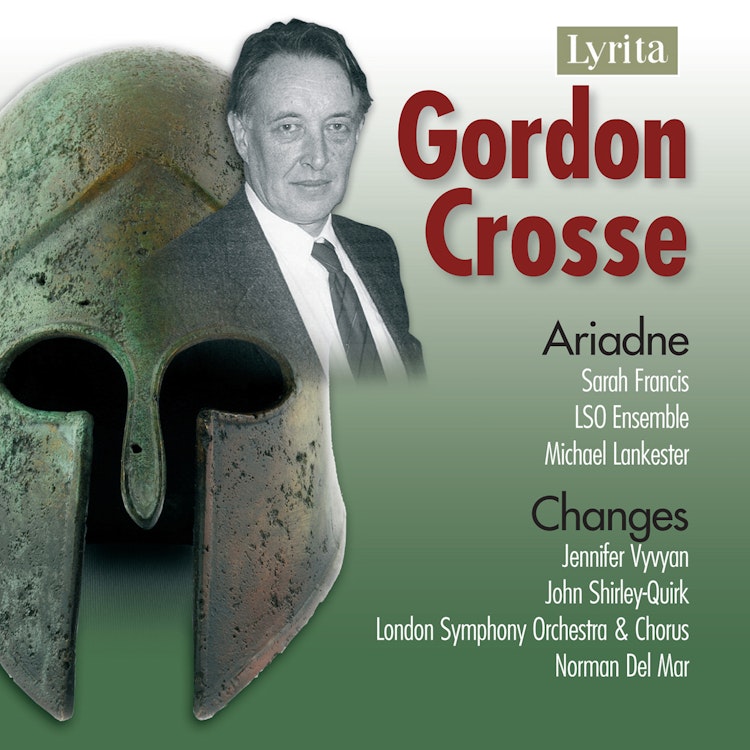
A pervasive motive, first heard on horns and bells at the opening of 'Changes', underlies about 80% of the music, expanded into a scale with notes freely permuted or transposed.
Composition History
'Changes' was commissioned by the National Federation of Music Societies for the 1966 Three Choirs Festival in Worcester.
Recording & Production
The recording of 'Ariadne' was made in Kingsway Hall, London, immediately after a performance at a BBC Prom concert in August 1974.
Composition History
The composer, Gordon Crosse, spent as much time choosing the text for 'Changes' as he did writing the music, due to the 'insufferable moral earnestness of English Oratorio'.
Composer's Artistic Vision
Gordon Crosse, the composer, aimed to create something enjoyable for both listeners and performers, especially challenging for a piece composed for the Three Choirs Festival.
Compositional Technique
The composer, Gordon Crosse, used thematic cross-reference and expressive unity, like the dramatic arch of Part III, to achieve unity across the many short sections and contrasts in 'Changes'.
Compositional Technique
The first part of 'Changes' uses 'doggerel' inscriptions from bells to create a large-scale, almost symphonic opening, contrasting with the shorter, lyrical sections that follow.
You might also enjoy...
Graupner: 2 Overtures & Cantata
Segerstam: Six Songs of Experience / String Quartet
Matthews: Complete String Quartets, Vol. 2
Sigmund Romberg: When I Grow Too Old To Dream
Agitata
Die Deutsche Schalmey ou La naissance du hautbois baroque