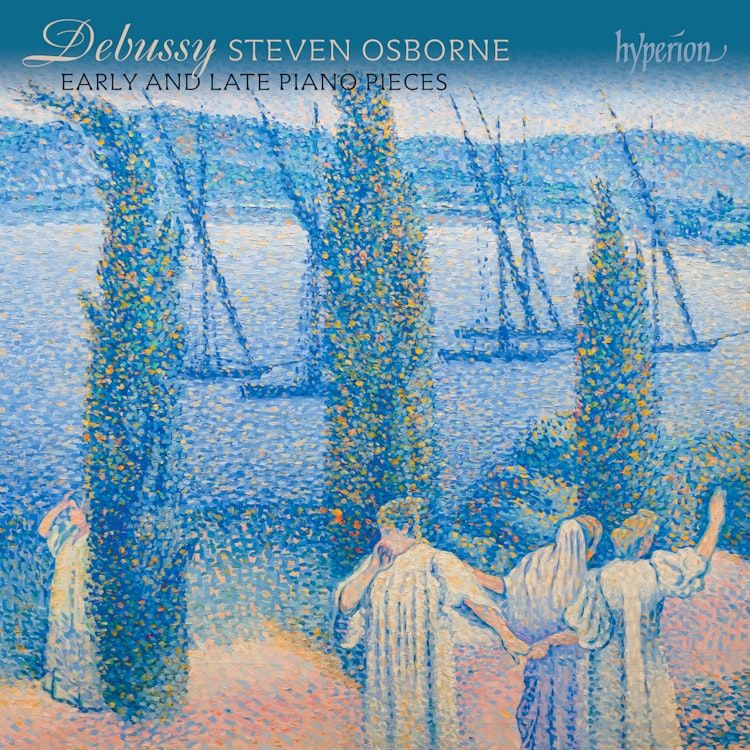
Steven Osborne, the pianist on this album, has received numerous awards including the Royal Philharmonic Society Instrumentalist of the Year (2013) and two Gramophone Awards.
Composer's Artistic Vision
Debussy's Images were dedicated to Yvonne Lerolle, the 17-year-old daughter of painter Henri Lerolle, and were described by the composer as 'conversations' between the Piano and Oneself.
Composition History
Debussy's last piano piece, Les soirs illuminés par l'ardeur du charbon, was a gift to his coal merchant, Monsieur Tronquin, who provided much-needed coal during the bitter winter of 1916/17.
Composer Biography
Claude Debussy's first known piano piece, Danse bohémienne, was written when he was seventeen, while he was acting as house pianist for Tchaikovsky's patroness Nadezhda von Meck.
Composition History
The Morceau de concours, a piano piece by Debussy, was published in 1905 in the review Musica, with readers asked to guess the composer's identity.
Historical Context
The cake-walk The little nigar, written by Debussy in 1909, was inspired by black parodies of white dancing, where slaves would mock the minuets and grand marches of white folks' parties.
Critical Reception
Tchaikovsky, after reviewing Debussy's Danse bohémienne, commented that it was 'Nice, but too short, with themes that don't go anywhere, and the form is bungled and not unified.'