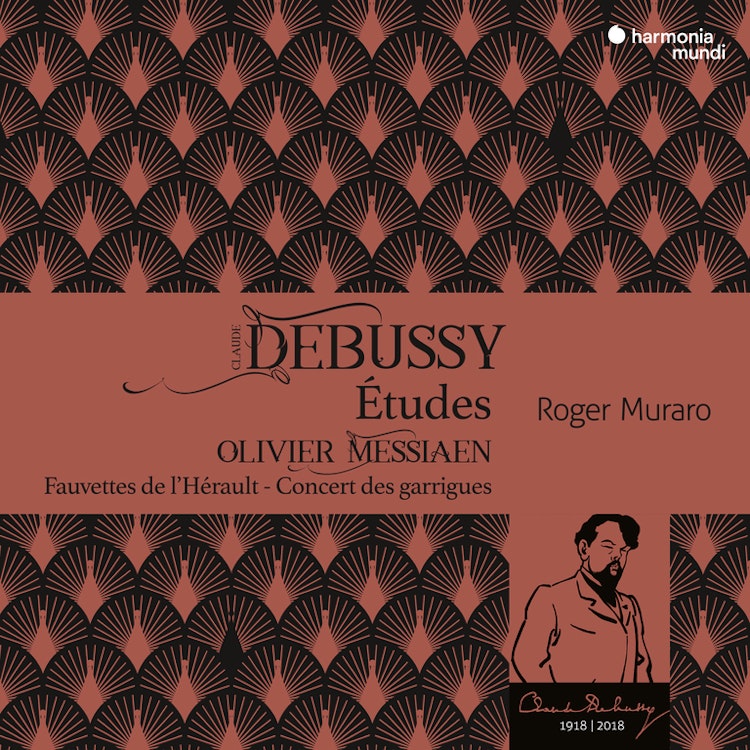
Debussy: Etudes - Messiaen: Fauvettes de l'Hérault - Concert des garrigues
11/30/2018, 15 Tracks, 1:13:13
Featuring
Roger Muraro
Claude Debussy
Olivier Messiaen
Did you know?
1/7
Composition History
Messiaen's Fauvettes de l'Hérault - Concert des garrigues was originally conceived as a concerto for piano and orchestra, commissioned to celebrate Debussy's centenary in 1962.
Composition History
The piano part of Messiaen's Fauvettes de l'Hérault - Concert des garrigues was reconstructed by Roger Muraro, the pianist on this album, from difficult-to-read sketches after the orchestral parts were lost.
Composition History
Debussy's Études, dedicated 'to the memory of Frédéric Chopin', originated from his editorial work revising Chopin's scores for his publisher Jacques Durand during World War I.
Composer Biography
Olivier Messiaen, a composer, was deeply influenced by Debussy's music, especially his opera Pelléas et Mélisande, and incorporated Debussy's ideas into his own teaching.
Compositional Technique
Debussy's Études intentionally contain no fingerings, with the composer stating that this 'absence of fingering is an excellent exercise' for pianists to find their own.
Historical Context
Debussy's Études were composed during World War I, a period of deep distress for the composer, who was also battling cancer.
Performer Biography
Roger Muraro, the pianist on this album, studied with Yvonne Loriod, a pianist who was Messiaen's wife and the dedicatee of his concerto 'on the birds of the Hérault'.