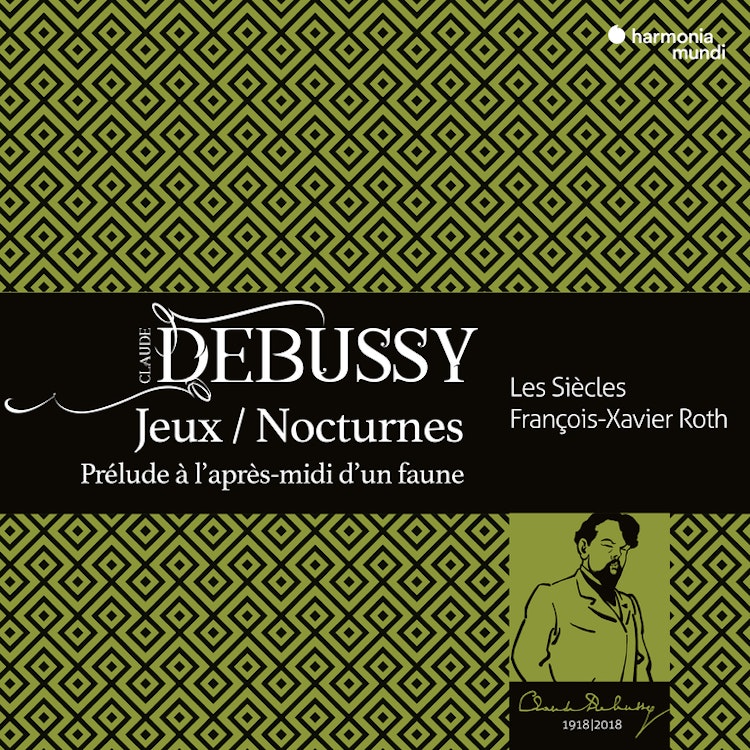
Debussy: Jeux, Nocturnes, Prélude à l'aprés midi d'un faune
12/7/2018, 5 Tracks, 50:52
Featuring
François-Xavier Roth
Les Siècles
Les Cris de Paris
Claude Debussy
Did you know?
1/7
Composition History
Debussy's Nocturnes were initially conceived for violin and orchestra, intended for violinist Eugène Ysaÿe, before becoming a purely symphonic work.
Compositional Technique
In the third Nocturne, "Sirènes," Debussy uses a women's chorus not as a vocal part with text, but as an orchestral timbre, instructing them to blend into the orchestra.
Composer's Artistic Vision
Debussy sought to free himself from traditional symphonic forms, aiming to restore "a little life and freedom to orchestral music."
Composer's Artistic Vision
Debussy chose the title Nocturnes to evoke the paintings of Whistler, whom he had met and whose works he admired.
Composition History
Jeux was Debussy's only completed ballet score, commissioned by Sergei Diaghilev for the Ballets Russes' 1913 season.
Compositional Technique
Debussy's Prélude à l'après-midi d'un faune marked a definitive turning point in his orchestral style, introducing a previously unknown flexibility into symphonic music.
Cultural Impact
Debussy's music profoundly influenced multiple generations of composers and was crucial to the "extraordinary sonic explosion of the twentieth century," impacting orchestration, musical architecture, and even jazz.
You might also enjoy...
Debussy : Jeux, Khamma & Le martyre de Saint-Sébastien
Debussy: Prélude à l'après-midi d'un faune, La mer & Jeux
Boulez Conducts Debussy
Debussy: Images, Jeux, & La plus que lente
Debussy: Orchestral Works, Vol. 1
Debussy: La boîte à joujoux, 6 Épigraphes antiques & Sarabande (Orch. Caplet, Ansermet & Ravel)
La Mer
Debussy: La Mer; La Boîte à joujoux (Children's Ballet); Prélude à l'áprès-midi d'un faune