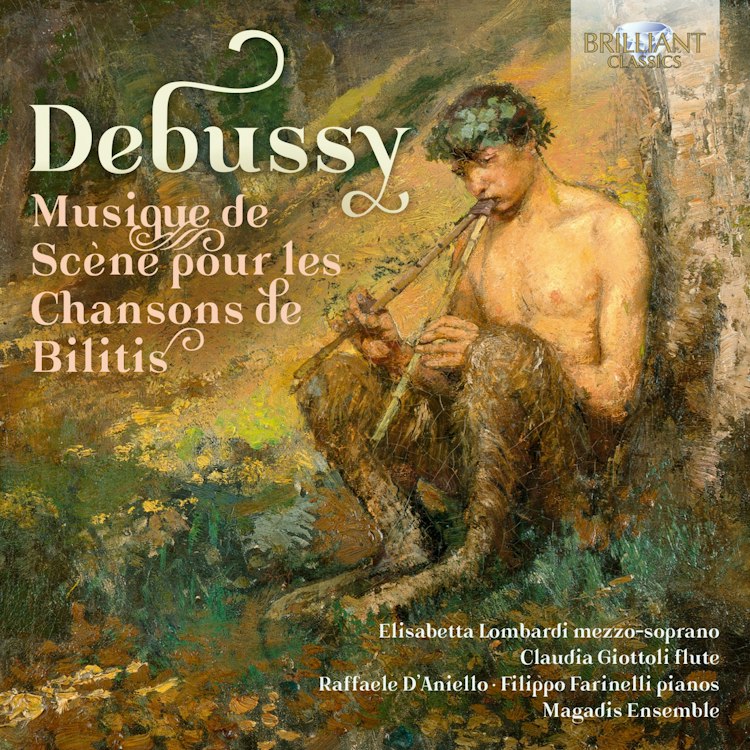
Debussy: Musique de scène pour les chansons de bilitis
1/25/2019, 22 Tracks, 54:09
Featuring
Elisabetta Lombardi
Filippo Farinelli
Carole Magnini
Raffaele D'Aniello
Claudia Giottoli
Magadis Ensemble
Claude Debussy
Did you know?
1/7
Composition History
The 1901 stage performance of Debussy's Les Chansons de Bilitis, featuring recitation and mime, was presented to an invited audience to avoid scandal due to the presence of half-naked models.
Composer's Artistic Vision
Pierre Boulez, a prominent composer and conductor, believed that modern music began in 1894 with Debussy's L'après-midi d'un faune.
Composition History
Debussy's solo flute piece, originally titled La Flûte de Pan, was renamed Syrinx by the publisher Jobert to prevent confusion with the first of his three Chansons de Bilitis.
Performer Biography
Elisabetta Lombardi, the mezzo-soprano on this album, was a finalist at the Cardiff 'Singer of the World' contest and has performed internationally.
Compositional Technique
For the stage music of Les Chansons de Bilitis, Debussy chose two flutes and two harps to represent the aulos and kythara, the two main sources of ancient Greek music.
Composition History
The text for Debussy's Chansons de Bilitis comes from a cycle of poems by Pierre Louÿs, which he claimed were translations of texts by a 6th-century BC Greek poetess, making them a literary forgery.
Performer Biography
Claudia Giottoli, the flautist, received enthusiastic reviews for her 2016 album of Giacinto Scelsi's Complete Flute Music, with The Guardian praising her 'dauntless performances'.
You might also enjoy...
Mcneff: 4 Tales From Beatrix Potter
Wolfgang Amadeus Groothof
The World of Harry Partch
Project Earth: The Blue Chapter
Norgard / Reich / Siegel / Veldhuis: Works for Percussion Duo
Heart of a Dog
Melodramas
Saint-Saëns: Karneval der Tiere & Prokofiev: Peter und der Wolf