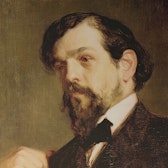
As a teenager, Debussy was accused of forcing his effects and playing with a certain amount of puffing and blowing, despite his mature piano playing being noted for smoothness and delicacy.
Recording & Production
This recording uses 24-bit / 96 kHz technology, which offers a dynamic range up to 48 dB greater and 256 times the resolution of standard 16-bit recordings.
Composition History
The Six Épigraphes antiques originated from incidental music Debussy wrote for a mimed recitation of poems by his friend Pierre Louÿs, which were spoofs on Sappho's writings.
Instruments
The pianos used for this recording are Bösendorfer Concert Grand 280VC 'Vienna Concert' models, which aim to combine the characteristic Bösendorfer sound with modern performance needs.
Composer's Artistic Vision
Debussy's motto for living and composing was 'toujours plus haut' (ever higher), reflecting his constant striving for new artistic ground.
Composition History
The piano duet was a common format for intimate music-making, and Debussy made his first known appearance as a duettist in 1880, playing with Tchaikovsky's patroness, Nadezhda von Meck.
Compositional Technique
Debussy's style often featured repeated phrases, which one critic unkindly referred to as his 'style bègue' or 'stuttering style'.