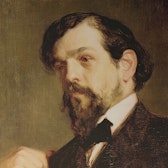
Claude Debussy's orchestral scores are effective on two pianos because his Impressionist orchestration emphasized individual instrumental lines rather than blending sounds.
Performer Biography
Yukie Nagai, a pianist born in Tokyo, won a special prize for the best Debussy interpretation at the Geneva International Piano Competition in 1977.
Composition History
Maurice Ravel, a colleague of Debussy, transcribed two of Debussy's orchestral works, Nocturnes and L'Après-midi d'un faune, for two pianos in 1909 and 1910.
Composer Biography
In 1889, at age 27, Debussy was influenced by composers like Godard, Massenet, Saint-Saëns, and Grieg, but also experienced Javanese gamelan music and Mussorgsky's Boris Godunov at the Paris World Exhibition.
Composer's Artistic Vision
Debussy's 'Spanish style' first appeared in Lindaraja, a nocturnal veil dance published in 1901, and was admired by Manuel de Falla for its grasp of the Spanish soul.
Historical Context
Four-handed piano playing was a common form of entertainment after World War II, often serving as a substitute for orchestral experiences.
Composer's Artistic Vision
Debussy referred to La Mer not as a 'symphonic poem' but as 'three symphonic sketches,' intending the music to offer a less defined image rather than a precise sequence of events.