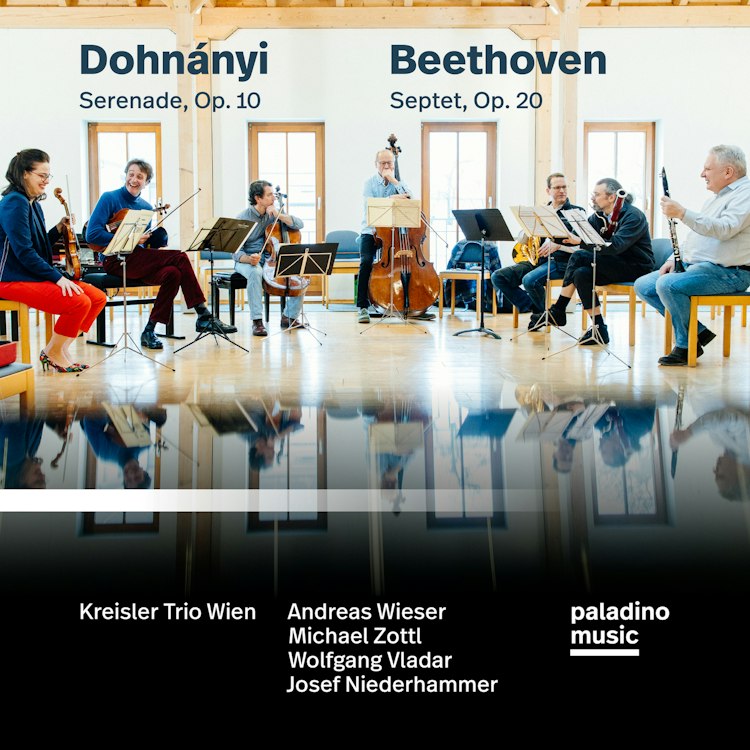
Beethoven's Septet, Op. 20, expands on Mozart's Divertimento K 563 by adding a double bass and a wind trio (clarinet, horn, bassoon) to the string trio formation.
Composition History
Johannes Brahms significantly helped the young Dohnányi's career by organizing performances of his Piano Quintet, even exclaiming, 'I couldn't have done it better myself!'
Composer's Artistic Vision
As a composer, Dohnányi remained committed to a late-romantic style, contrasting with his friends Béla Bartók and Zoltán Kodály.
Composition History
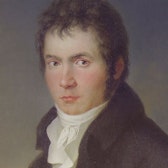
Beethoven's Septet, Op. 20, was premiered at his first 'Academy' in the Vienna Hofburg Theater on April 2, 1800, alongside his first symphony and piano concerto.
Composer Biography
Ernst von Dohnányi, a child piano prodigy, studied with pupils of Franz Liszt and Johannes Brahms at the Budapest Music Academy.
Compositional Technique
Dohnányi's Serenade, Op. 10, is formally modeled after Wolfgang Amadeus Mozart's Divertimento K 563 and Ludwig van Beethoven's Serenade, Op. 8.
Critical Reception
Beethoven's Septet, Op. 20, was his most performed and popular work during his lifetime, leading to many transcriptions by various publishers.
You might also enjoy...
Beethoven Berwald Septets
Schoenberg: Ode to Napoleon; Webern: String Trio
Italian Airs and Dances
Klein, Krása, & Schulhoff: Forbidden Music
Old Souls
Corradini: Partitura del Primi Libro de' canzoni francese a 4 & alcune suonate - Merula: Tre Canzoni Strumentali
Dvořák: Piano Quintet No. 2 in A Major, Terzetto, Drobnosti & Gavotte
Piotr Szewczyk: Bliss Point – Selected Chamber Works
The Auryn Series, Vol. 32
Klein, G.: String Trio / Schulhoff, E.: Duo for Violin and Cello / Violin Sonata / Krasa, H.: Passacaglia and Fugue / Tanz