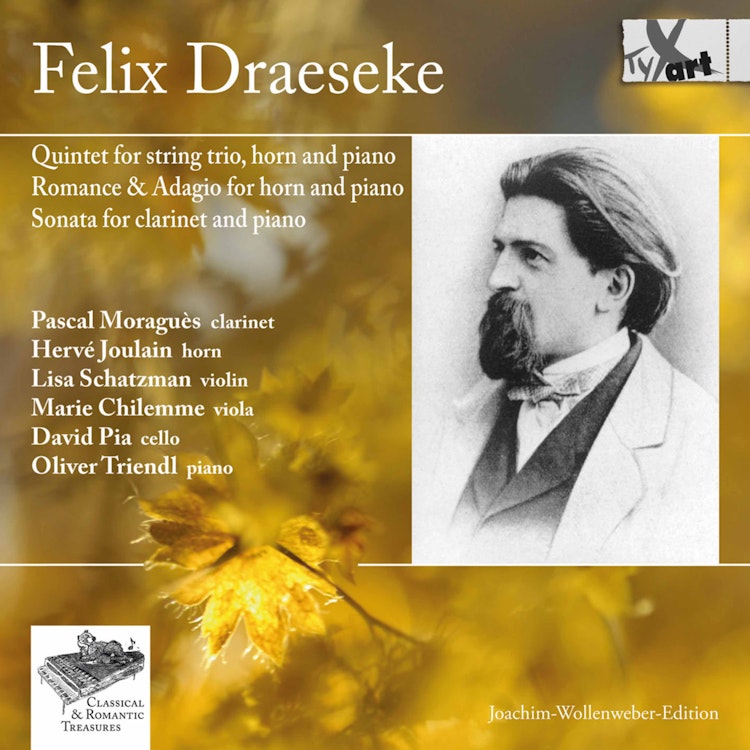
Felix Draeseke completed his Sonata for clarinet and piano in B-flat major, Op. 38, in 1887, around the same time as his major symphonic work, the Symphony in C major, Op. 40 (Sinfonia tragica).
Composer Biography
Felix Draeseke, born in 1835, came from a family of clergy but chose a career in music after becoming fascinated with Wagner's music.
Composer Biography
Felix Draeseke suffered from hearing impairment from a young age, which prevented him from becoming a performer, and he eventually lost his hearing completely in old age.
Composition History
Felix Draeseke's Quintet for piano, violin, viola, cello, and horn, Op. 48, was composed in autumn 1888, at the same time as his symphonic poem Penthesilea.
Historical Context
In 1887, when Felix Draeseke composed his Clarinet Sonata, the repertoire for demanding clarinet and piano pieces was sparse, as major sonatas by Brahms, Saint-Saëns, and Reger were yet to be written.
Compositional Technique
The Quintet Op. 48 features a restrained horn that adds a warm, orchestral touch, while the piano brings it closer to a large-scale concerto format.
Critical Reception
For decades, Felix Draeseke was largely overlooked, possibly because he navigated between the opposing New German School and conservative factions of the 19th century, receiving a lukewarm reception from both.