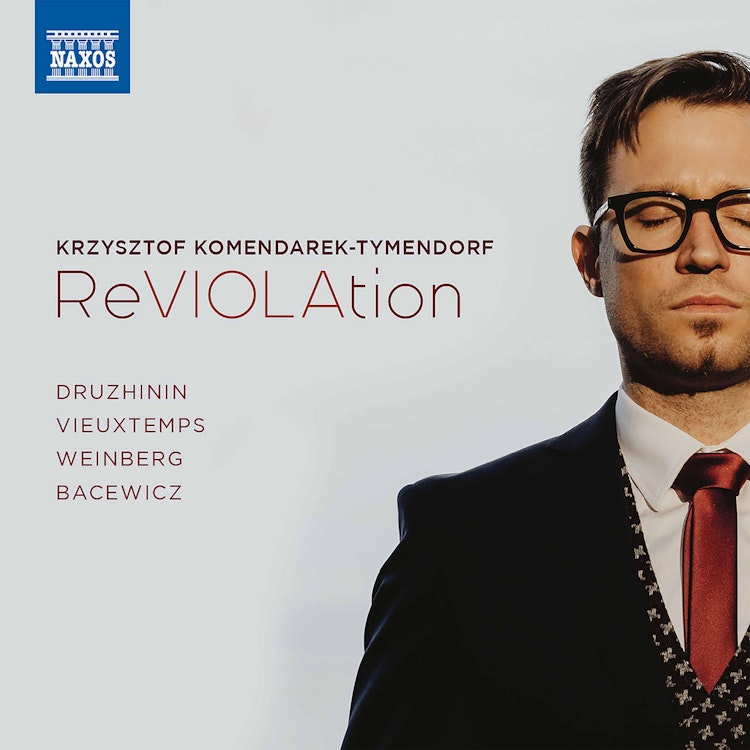
Druzhinin, Weinberg, Vieuxtemps & Bacewicz: Viola Works
11/27/2020, 11 Tracks, 50:56
Featuring
Krzysztof Komendarek-Tymendorf
Fyodor Druzhinin
Mieczysław Weinberg
Henri Vieuxtemps
Grażyna Bacewicz
Did you know?
1/7
Composer Biography
Fyodor Druzhinin, whose sonata is featured, was one of the most valued Soviet viola virtuosos and a student of Vadim Borisovsky, eventually taking his place in the famous Beethoven Quartet.
Historical Context
The sonatas by Fyodor Druzhinin and Mieczysław Weinberg form a diptych, connected by their composers' shared experience of living in the USSR during the time of Joseph Stalin.
Album & Artwork
The album title, "ReVIOLAtion," implies a "viola revolution," aiming to showcase the instrument's versatility and challenge its lower position among string instruments.
Interpretation
Krzysztof Komendarek-Tymendorf, the violist, approaches each work by decoding it through his own experience, leading to an intriguing and sometimes controversial interpretative concept.
Composition History
Grażyna Bacewicz's Polish Caprice, one of her most famous works, was originally written for violin in 1949, and the version on this album was transcribed for viola by Jerzy Kosmala.
Instruments
The album was recorded on a master viola built by Gerhard Ernst in Eugen Sticht's luthier workshop in 1988.
Composer's Artistic Vision
Mieczysław Weinberg, composer of the Viola Sonata No. 3, viewed the viola as an instrument with high potential for melodiousness, possessing a mysterious, ambiguous, and liberating sound.
You might also enjoy...
Viola Recital
Women’s Works: Works for Solo Viola by American Women
Transforming Viola
Bach, J.S.: Six Suites for Unaccompanied Cello (Transcribed For Viola)
J.S. Bach: Cello Suites Nos. 1-6, BWV 1007-1012 (Arr. for Viola by Marc Sabbah)