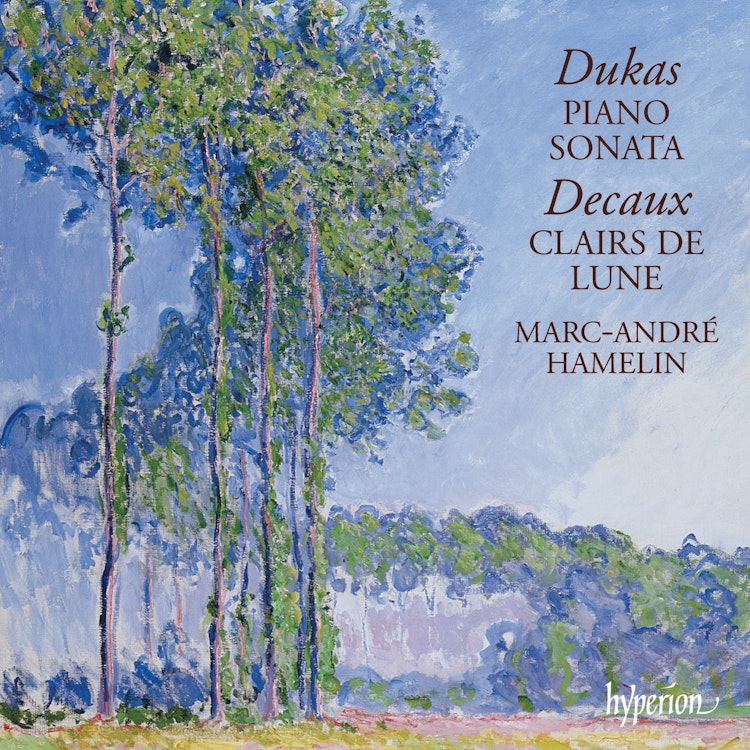
Abel Decaux's Clairs de lune pieces, written between 1900 and 1907, feature extraordinary harmonies and syntax, including whole tone aggregations and consecutive fifths, predating similar techniques by Schoenberg and Debussy.
Composition History
The Société nationale de musique, founded in 1871, promoted French music and aimed to show the world that France was not inferior to its German neighbors in the musical field.
Composer Biography
Abel Decaux, who was organist at Sacré-Cœur for 25 years, only has four known works, the Clairs de lune on this album, apart from sketches for a fifth piece.
Composition History
Many prominent French composers, including Gounod, Massenet, Debussy, and Ravel, did not write a piano sonata, making Dukas's completion of his sonata in 1900 a pioneering effort.
Composer's Artistic Vision
Paul Dukas described his Piano Sonata as an 'analogy between victory over the beast within' and the 'victory' over the 'beast without', drawing a parallel to ancient Greek myths.
Historical Context
French piano music between 1870 and 1914 was strongly influenced by the 'Impressionist' writing of composers like Debussy and Ravel, but this was not the complete picture.
Composer's Artistic Vision
Dukas's decision to write a piano sonata was influenced by the rising reputation of Beethoven in France around 1900, leading to a work with 'moral and competitive elements'.
You might also enjoy...
Martin Perry Plays Gordon Binkerd & Charles Ives
Rosenberg: Piano Works, Vol. 1
Virtuoso Piano Music
Enescu: Piano Music Vol. 2
Kalevi Aho: Piano Works
Merilainen: Piano Sonatas Nos. 2, 4, 5 & Papillons
Iman Album 1: James W. Iman Plays Schoenberg, Boulez, Webern & Amy
Liszt Wagner Reubke
Aus Wien
Neglected Works for Piano
Rochberg: Piano Music, Vol. 3
Pianoworks
In finstrer Mitternacht Brahms, Op. 5 & Op. 7 9
Franck: Piano Transcriptions / Violin Sonata / Pastorale