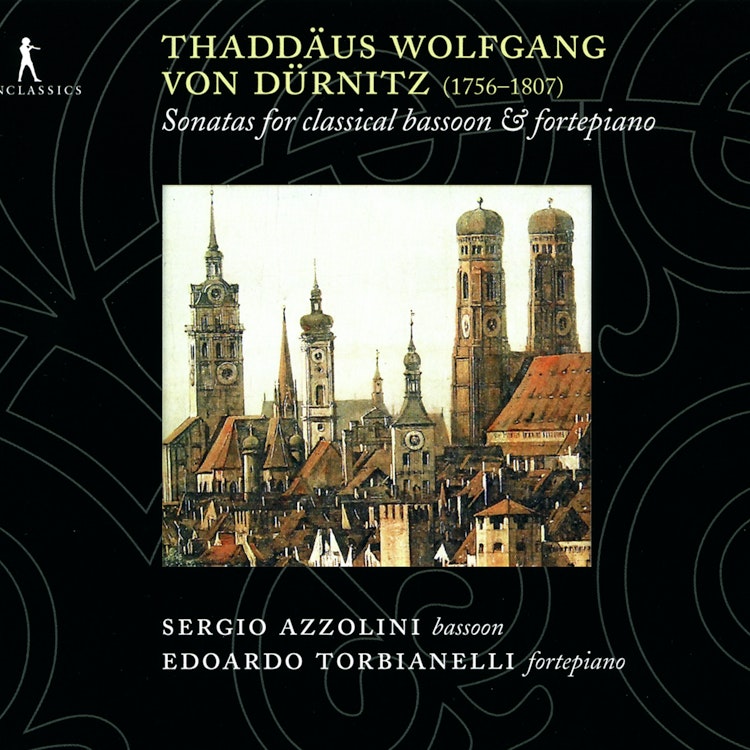
Durnitz: Sonatas for Classical Bassoon and Fortepiano
4/1/2008, 12 Tracks, 1:13:29
Featuring
Sergio Azzolini
Edoardo Torbianelli
Thaddaus Wolfgang von Durnitz
Did you know?
1/7
Instruments
The bassoon used for this recording is the only playable, well-preserved example from the workshop of Isaac Keller, a significant witness to 18th-century sound and tuning.
Compositional Technique
Baron Dürnitz's sonatas, composed around 1780, are two-movement works characterized by a preference for fast tempi, unlike the more substantial sonata Mozart wrote for him.
Composer's Artistic Vision
Dürnitz's sonatas are among the earliest works for the bassoon and keyboard combination, offering the bassoonist rich opportunities to showcase the instrument's lyrical qualities.
Instruments
The bassoon used in this recording belonged to Etienne Ozi, a renowned bassoon virtuoso of the 18th century, and was made by Isaac Keller between 1760 and 1770.
Composer Biography
Thaddäus Wolfgang von Dürnitz, the composer of these sonatas, was born in 1756, the same year as Mozart, and was an active musician and composer despite his public office.
Performer Biography
Etienne Ozi, a bassoon virtuoso of the 18th century, published the "Nouvelle méthode de basson" in 1803, which became a standard teaching work for the instrument throughout the 19th century and remains so today.
Composition History
Mozart composed his Piano Sonata in D major, KV 284, for Baron Dürnitz in 1775, but Dürnitz never paid him for the work.
You might also enjoy...
Purahéi Che Retãgua
Various Composers: Baroque - Bolero - Barocke Musik Für Posaune Und Orgel (Baroque Music for Trombone and Organ)
Poems of Love & Other Works
Bennett: Piano Sextet, Chamber Trio & String Quartet