Dussek's collaboration with piano builder John Broadwood led to the development of fortepianos with an extended keyboard range, first of five and a half octaves, then six octaves.
Performer Biography
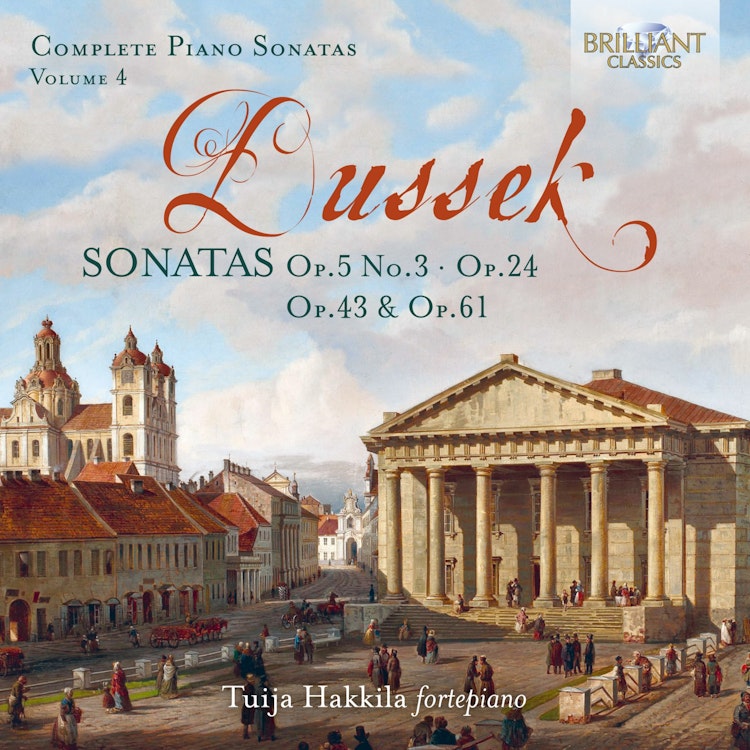
Tuija Hakkila, the pianist on this album, studied at the Sibelius Academy and the Paris Conservatoire, and has held a senior teaching position in piano music at the Sibelius Academy since 1987.
Composer Biography
Dussek led a restless life, traveling from his origins as a choir boy in rural Bohemia to major cultural centers like Paris, London, and St. Petersburg, performing on harpsichord, fortepiano, and glass harmonica.
Recording & Production
This album is part of an extensive recording project that will result in the first comprehensive recording of Dussek's piano sonatas performed on period instruments.
Composer's Artistic Vision
The characteristic sound and touch of the English fortepiano inspired and shaped the development of Dussek's compositional style, lending itself to his preferred harmonic fullness.
Composer Biography
Johann Ladislaus Dussek (1760-1812) was considered one of the foremost keyboard performers and composers of his era, creating nearly 300 compositions, mostly involving a keyboard instrument.
Interpretation
Pianist Tuija Hakkila is committed to period instrument performance, presenting baroque, classical, and romantic programs on historical pianos ranging from early Silbermann fortepianos to late romantic pianos.
You might also enjoy...
Piano Lessons - Piano Sonatas by Haydn, Mozart, Beethoven